
KRA Riding Proficiency Certification
A riding skills certification run by the Korea Racing Authority (KRA), known as KHIS. You take the levels in order from Level 7, and each level has a written, oral and practical exam.
Levels
Levels 7 to 4 are the same for all disciplines; from Level 3 they split into dressage, show jumping and eventing. In principle, general levels are taken in order from Level 7. Riders aged 18 and over may start at Level 6, but we recommend starting at Level 7. Pony levels for children are separate.
| Level | Recommended riding experience | Standard |
|---|---|---|
| Level 7 | 4–6 months | Learning the basics of riding: horse behaviour, horse care, leading a horse |
| Level 6 | 6 months–1 year | Riding all three gaits: walk, trot and canter |
| Level 5 | 1–2 years | Riding a horse towards a jump and jumping it |
| Level 4 | 2–3 years | Controlling the horse's speed and direction freely |
| Level 3 | 3–4 years | Taken by discipline. Ready for F Class at official competitions |
| Level 2 | 4–5 years | Advanced recreational rider. Ready for D Class |
| Level 1 | 5 years or more | Top recreational level. Ready for A Class |
| Pony Levels 3, 2, 1 | 10, 20, 30 rides | Children's levels covering beginner walk, sitting trot and rising trot. Guri Riding Club teaches middle school students and older only |
Exam format
Exams are run by the KRA certification office and held at riding facilities it designates. Each level is assessed on the five parts below.
Pass marks and exam dates are published in the exam notices on Horsepia. There is currently no exam fee for general levels.
- Written testBasic knowledge of horses and riding
- Oral testAnswering the examiner's questions
- Practical: horse careTack-up assessment, including grooming tools, hoof picking, and fitting saddle and bridle
- Practical: ridingRiding the set course for the level
- Practical: leadingLeading the horse over a set section, halting and turning
Level 7
At this level you build confidence riding on your own and learn to care for the horse. You may have a helper for grooming and saddling.
| Tack-up | Leading | Riding |
|---|---|---|
| Using grooming tools Picking out front hooves Putting on and taking off the saddle with a helper Putting tack away |
Leading at walk and trot Halting at a set point |
Mounting in the correct order Basic position Walk–trot transitions Changes of direction Riding over ground poles Halt |
Leading course
Lead the horse at walk from the start to a turning point 15 m ahead, go round it clockwise, then come back at trot and halt.
Riding course (about 40×30 m)
- Cone slalom, walkWeave between 4 cones set 4 m apart. Go left around the first cone and change direction with opening and closing reins.
- Circle, walkRide an even circle of 8–12 m diameter around a post.
- 4 ground poles, trotRide straight over the centre of the poles in an active trot. Spacing is 90 cm for horses, 80 cm for ponies.
- Under a high bar, trotLean forward to pass under a bar set at 1.9–2.5 m. This practises avoiding branches on hacks.
- Halt box, 3-second haltIn a 3×4 m box, come down from trot to walk to halt, stand for 3 seconds, then move off again at walk and trot.
- FinishCome down to walk and halt, praise the horse, then dismount.
Level 7 checklist
Check with your coach during lessons whether you can do each of these on your own.
On the ground
- I can approach a horse in its stall and put on a headcollar
- I hold the lead rope correctly, without wrapping it round my hand
- I know the names and order of the grooming tools
- I can lift a front foot and pick out the hoof
- I put on the pad, half pad and saddle in that order
- I check the girth by sliding my hand under it
- I rinse the bit in water straight after use
Riding
- I set my stirrup length using my arm's length
- I mount from the horse's left side using a mounting block
- I dismount by sliding down, not jumping
- I can tell natural aids (seat, legs, hands) from artificial aids (whip, spurs)
- I keep a steady rising trot rhythm
- I change direction with opening and closing reins
- I make smooth transitions between walk, trot and halt
Level 6
View course
You now do on your own what you did with a helper at Level 7, and canter and forward seat are added.
| Item | Level 7 | Level 6 |
|---|---|---|
| Saddling and unsaddling | With a helper | On your own |
| Hoof picking | Front feet | Front and hind feet |
| Mounting | Using a mounting block | From the ground, without a block |
| Gaits | Walk, trot | Walk, trot, canter |
| Leading | Straight line at walk and trot | Cone slalom, moving the head left and right, 2 steps of rein-back |
| Position | Basic position | Basic position, half seat, forward seat |
Riding course (30×40 m)
- Half seat for 3 seconds, walkOn the first long side, shorten the reins and put your weight evenly into both stirrups.
- Right circle, rising trotRide one and a half circles of 10–15 m diameter and leave on the diagonal.
- Left circle, rising trotRide the same size circle the other way, and change your rising diagonal in the middle of the diagonal.
- Canter transitionRide a few strides of sitting trot, then ask for canter with your aids.
- Ground pole, forward seatRide over a ground pole at trot and again at canter, approaching straight through the centre.
- FinishCome down from trot to walk and halt to finish.
Level 5
View course
At this level you use the reins and your seat to make smooth transitions between gaits. Fitting front leg boots is added to the tack-up assessment.
| Tack-up | Riding |
|---|---|
| Using grooming tools Putting on and taking off the saddle without a helper Adjusting the bridle Fitting front leg boots |
Adjusting stirrups while mounted Riding with one hand Size and balance of circles Sitting trot, halt and rein-back Trot–canter transitions, simple change of leg Low cross-pole jump (optional) |
Riding course (30×40 m)
- Stirrup adjustmentAdjust your stirrups while mounted before you start.
- One-handed corridor, walkRide through a 3 m wide corridor, switching the reins to the right hand, left hand and both hands at each cone.
- Trot circles, 10–12 mRide the right circle in rising trot and the left circle in sitting trot.
- Halt, immobility, rein-backHalt in the middle of the diagonal, stand still, then rein back 1–2 steps.
- 3 ground poles, rising trotRide straight over the centre of the poles.
- Canter circles, 12–15 mRide a circle in left canter, come through trot and walk, then change to right canter and ride one and a half circles.
- Optional sectionEither jump a 40 cm cross-pole at trot, or stand still for 3 seconds in the halt box.
Level 4
View course
At this level you make transitions exactly at set points and jump related fences in a steady rhythm. Fitting a martingale is added to the tack-up assessment, and you tighten the girth while mounted.
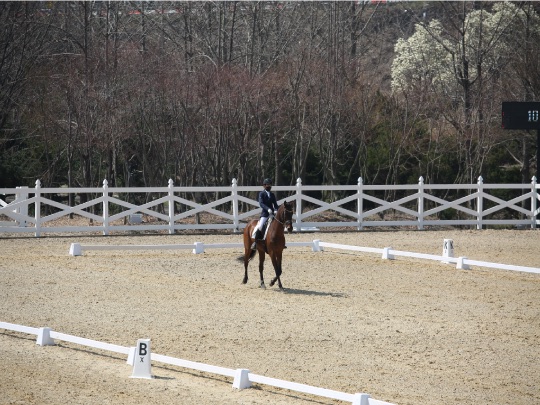
Riding course (30×40 m, using arena letters)
- Start at B, sitting trotMove off in working trot.
- 12 m circle left at C, left canterRide a circle that crosses the centre of a pole, and strike off into canter where the circle ends.
- 4 ground poles at E, canterRide over poles spaced 2.7 m apart (2.3 m for ponies) in a steady rhythm.
- Related fences on the diagonal from FJump two 20 cm uprights 15 m apart in 4 strides (5 for ponies), then come back to trot.
- Right canter at H, 15 m circle right at CStrike off into canter exactly at the marker and ride the circle in a steady rhythm.
- Related fences on the diagonal from MJump two cross-poles (50–60 cm) 16 m apart in 4 strides (5 for ponies), then come back to trot.
- Left canter at K, 15 m circle left at ARide the circle in canter, then come back to trot.
- Halt at BHalt, stand still and keep a correct position.
The actual exam course follows the exam notice and the examiners' instructions.