
Riding
The beats of the walk, trot, canter and gallop
· 4 min read
A horse's basic gaits are told apart by the number of hoofbeats in each stride. The walk has four beats, the trot two, the canter three and the gallop four again. Knowing the beats and the moments of suspension makes it easier to read the horse's movement from the saddle.
A horse's four basic gaits, from slowest to fastest, are the walk, trot, canter and gallop, and what separates them is the beat rather than the speed. The walk has four beats, the trot two, the canter three and the gallop four. A beat here means how many times a hoof is heard striking the ground during one stride. These four gaits appear in almost every breed without special training, and all of them can be seen in wild horse herds.
Beats and moments of suspension
Two things are used to tell the gaits apart. One is the order in which the hooves land and the number of beats. The other is whether there is a moment when all four legs are off the ground, known as suspension. A US university extension guide sums it up: in one stride the walk has no suspension, the trot has two periods, and the canter and gallop have one each.
The Dressage Judging Manual of the International Federation for Equestrian Sports (FEI) defines the gaits on the same basis. The walk is a four-beat pace in eight phases with no suspension. The trot is a two-beat pace in which diagonal legs move alternately. The canter is a three-beat pace in six phases. Judges mark whether this beat stays regular.
The walk: four beats, always on the ground
At the walk the legs land one at a time in the order left hind, left fore, right hind, right fore, giving an even "one, two, three, four". The average speed is about 7 km/h. The body is always supported by two or three legs, and the horse balances by moving its head and neck slightly up and down.
The further the hind hoof steps beyond the print left by the front hoof, the smoother and more comfortable the walk becomes. The FEI manual treats it as a serious fault when the foreleg and hind leg on the same side move almost together, because the walk then turns into something close to a lateral gait, in which the legs on one side move together.
The trot: two beats on diagonal pairs
At the trot the left fore and right hind, and the right fore and left hind, land together as pairs, with a moment of suspension between each pair. The average speed is about 13 km/h. It is a stable gait, so the horse does not need large balancing movements of its head and neck, and a horse in good condition can usually keep up a trot for hours. The canter and gallop, by contrast, can only be held for short spells, after which the horse needs to rest.
At each beat of the trot the horse's body drops slightly and then springs up again as the next diagonal pair lands. Many riders therefore use the rising trot, standing for one beat and sitting for the next, to let the bounce pass. The sitting trot, in which the rider stays in the saddle, can only be ridden for long periods with well-conditioned back and stomach muscles.
The canter and gallop: from three beats to four
The canter is three beats followed by one moment of suspension. According to the FEI manual, in canter to the right the hooves land left hind, then right hind and left fore together, then right fore, after which all four legs are in the air. The foreleg that lands last and reaches furthest forward is called the "lead", and on a circle a correct canter is normally on the inside lead. The average speed is 16 to 27 km/h, depending on stride length.
The gallop is the canter with a longer stride. Once the stride is long enough, the diagonal pair that landed together on the canter's second beat separates and the gait becomes four beats. With an average speed of 40 to 48 km/h it is the fastest gait, but a horse usually needs to rest after galloping more than 1.5 to 3 km. If the gallop is shortened and collected, it turns back into a canter.
Useful points
- Montana State University's guide notes that the moment of suspension is a good time to ask for a change of lead in the canter. Changing lead without breaking the gait is called a flying change.
- In a "disunited canter", the forelegs are on one lead and the hind legs on the other, so the fore and hind legs on the same side land together on the second beat. Balance and rhythm are hard to keep, and it is penalised at horse shows.
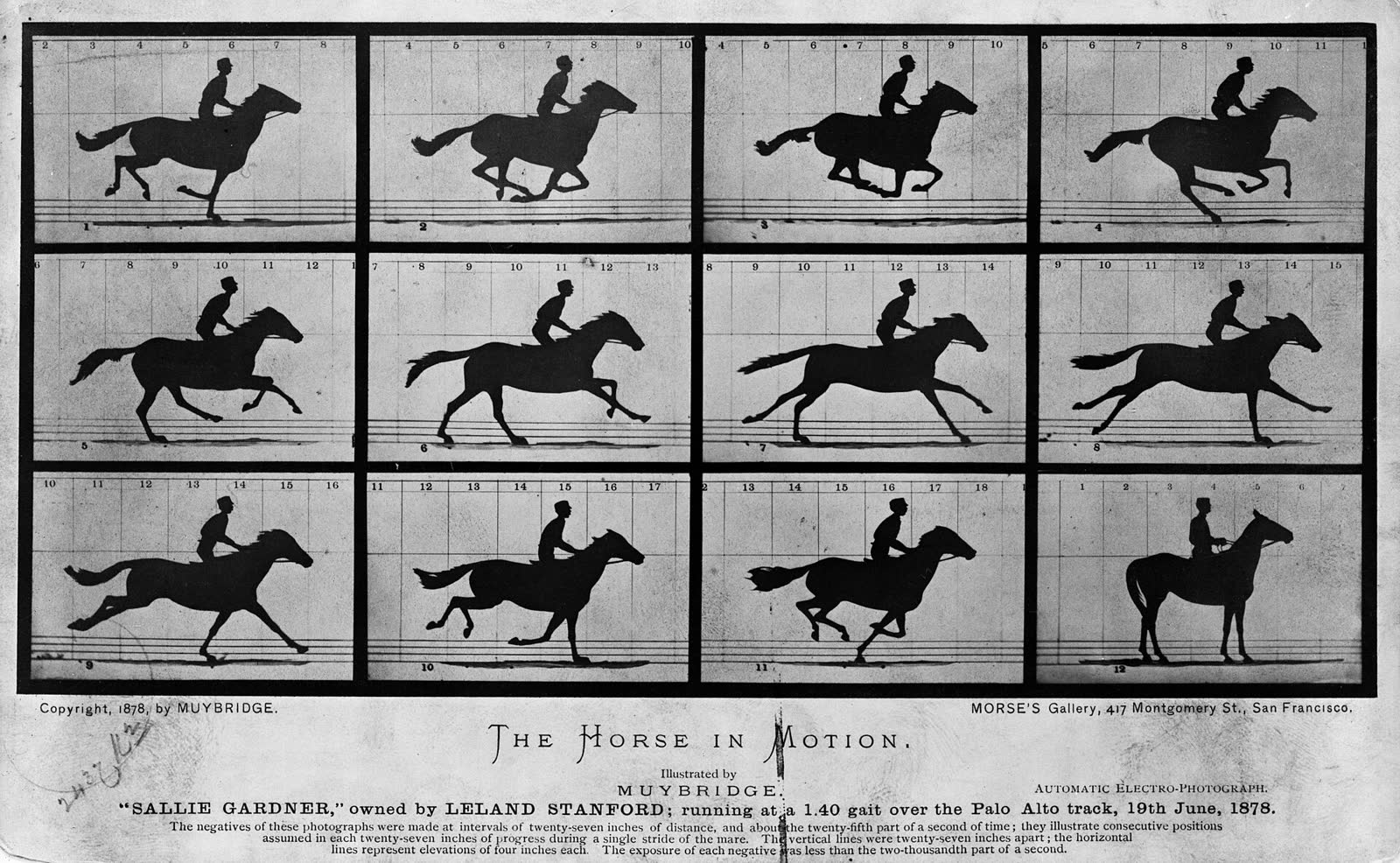
- Whether all four legs of a running horse really leave the ground at once was long debated. Leland Stanford, who bred racehorses, believed that pictures of running horses at the time were wrong, and in 1878 the photographer Eadweard Muybridge recorded a running horse's movement step by step in the sequential photographs of "The Horse in Motion".
Sources
- Wikipedia (English), Horse gait
- Wikipedia (English), Canter and gallop
- International Federation for Equestrian Sports (FEI), Dressage Judging Manual (effective 1 January 2024)
- eXtension Horses (US university cooperative extension), Gaits of the Horse
- Montana State University Extension, Locomotion
- Wikipedia (English), The Horse in Motion