
Riding
The dressage dress code
· 4 min read
At international dressage events, riders must wear protective headgear, white or off-white breeches, stock and gloves, and black or dark boots. Since 2021 a helmet has replaced the top hat, and the jacket may be any single colour.
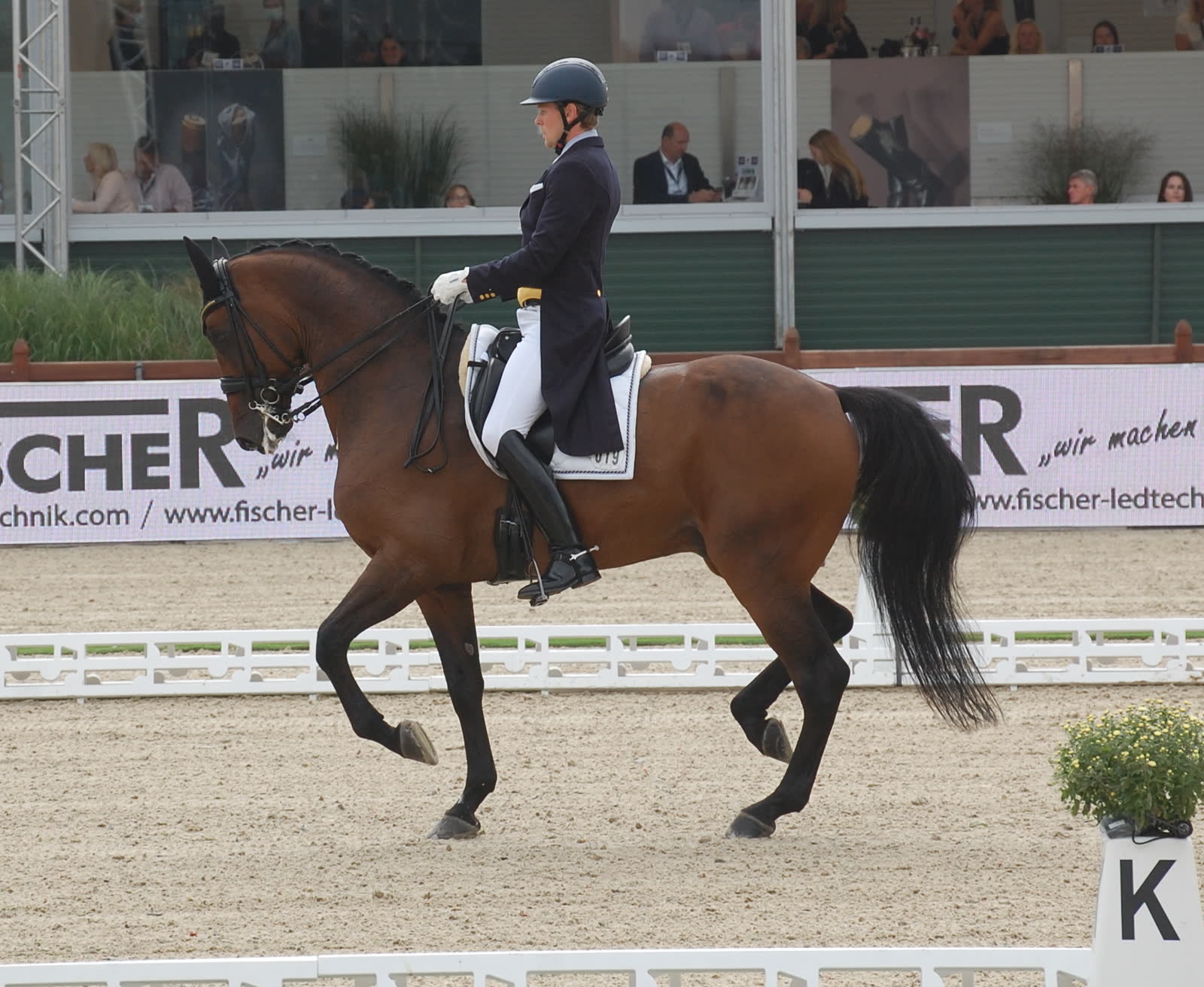
Dressage clothing is not a fashion choice but a competition uniform set out in the rules. Article 431 of the FEI (International Equestrian Federation) Dressage Rules makes five items compulsory for civilian riders: protective headgear in black or a dark colour, white or off-white breeches, a white or off-white stock (a riding neckcloth), gloves in white, off-white or the same colour as the coat, and black or dark riding boots. Since 2021 riders must wear protective headgear at all times when mounted, so the top hat, long a symbol of dressage, has disappeared from international arenas.
The basic dress under FEI rules
Any single-colour tailcoat or jacket approved by the rider's national federation is allowed. Striped or multi-coloured coats are not permitted, but tasteful, discreet accents such as a collar in a different shade, modest piping or crystal decorations are acceptable. At pony and children's events and at events for five- and six-year-old young horses, a jacket must be worn.
There are weather exceptions. In bad weather the Ground Jury may allow a light waterproof coat, and in very warm weather it may allow riders to compete without a jacket. Military and police riders, and members of national studs and national riding schools, may wear service dress instead of civilian dress at international events, but they must follow the same headgear rules.
There are also rules on what riders carry or wear alongside their clothes.
- Spurs: optional. Specifications follow the FEI tack and equipment requirements document.
- Earphones: earphones and other electronic communication devices are prohibited while competing, and using them means elimination. One earphone is allowed during training and warm-up.
- Whips: no whip of any kind may be carried in the competition arena. In the practice area one whip up to 1.2 m long (1 m in pony competitions) is allowed, and it must be dropped before entering the space around the arena.
From top hat to helmet
At the 2019 FEI General Assembly, national federations voted to make protective headgear compulsory across ridden disciplines. Dressage was given a one-year exemption, and the rule took effect on 1 January 2021. In October 2020, before it came in, 151 of the world's top dressage riders signed a petition asking to keep the choice of a top hat, at least in senior Grand Prix competition. They argued that there had never been a serious accident at an international dressage competition and that the top hat was part of the identity of the sport.
In November 2020 the FEI Board voted unanimously to implement the rule as planned, citing safety and the fact that the rule had been adopted by the General Assembly after a full consultation. The current rules say that any rider without properly fastened headgear must immediately stop riding, and that a rider who removes their headgear does so entirely at their own risk. Protective headgear shaped like a top hat may be used. Children, pony riders, juniors, young riders and under-25 riders must also wear headgear at the horse inspection, where horses are led in hand.
Tailcoats and stocks: clothes from tradition
The tailed jacket worn at the upper levels is called a shadbelly. It is usually black or navy and is traditionally worn over a canary-yellow waistcoat, or with yellow points showing below the cut-away front to look like one. Also worn in fox hunting, it is regarded as the most formal riding coat. Dressage tails are longer and weighted, unlike the shorter, unweighted tails used in the hunter ring (classes judged on a hunter's way of going and manners).
The stock also comes from the hunting field. After an accident it could be untied and used as a temporary bandage for a horse's leg or a sling for a rider's arm, and it kept wind and rain out of the collar. Today it is held in place with a pin through the knot. According to Wikipedia, lower-level riders often choose black gloves because white gloves make unsteady hands more noticeable, and long hair is tidied away in a net.
What judges check, and common misconceptions
Incorrect dress is penalised. Under Article 424, entering the space around the arena or the arena itself with a discrepancy in dress, such as missing gloves, is a technical fault, and each judge deducts 0.5 percentage points. These deductions are not cumulative and do not lead to elimination. Riders must also appear at the prize-giving in the same dress and saddlery as in the competition (Article 427).
A common misconception is that spurs are compulsory at the upper levels. Wikipedia says they are, but the 2026 FEI rules make spurs optional. The idea that only black or navy jackets are allowed also does not match international rules. Everything here refers to FEI international events. National and lower-level competitions follow the rules of their own organisers, so riders should check the schedule of each event before entering.
Sources
- FEI, Dressage Rules 2026, Articles 424, 427, 431 and 434
- Dressage-News, Top Hats Off, Protective Headgear On for All Dressage Competitors, 19 November 2020
- Eurodressage, Top Riders Sign Petition to Retain the Choice for a Top Hat in Grand Prix Competition, 26 October 2020
- Wikipedia, Dressage
- Wikipedia, Shadbelly
- Wikipedia, Stock tie