
Riding
What the Level 7 riding proficiency test checks
· 4 min read
Level 7 of the KRA Riding Proficiency Certification is the first step for beginners. It covers far more than riding: approaching a horse, grooming and tacking up, leading, oral and written questions, and a walk and rising trot course, scored across 21 items with a 70% pass mark.
Level 7 of the KRA Riding Proficiency Certification (기승능력인증) looks first at whether a rider can handle a horse safely, not at how well they ride. The certification is run by the Korea Racing Authority (KRA), which acts as the certifying body and assesses riders on seven levels. Level 7 is the first. The KRA describes it as "the stage of learning the basics of riding", where a rider understands horse behaviour, horse care, leading and putting on tack. Around four to six months after starting to ride is given as a guide.
Why the test covers more than riding
The operating manual says the test includes tacking up (fitting the saddle and bridle), leading and a theory exam alongside the riding assessment to stress respect for the horse as the rider's partner. The scheme also aims to help riding centres and instructors know each rider's ability, so they can assign horses safely and teach at the right level.
Levels 7 to 4 use a common course built from tasks every rider needs, ridden on a hired horse or the rider's own. The order is the written test, oral questions, grooming and tacking up, leading, and then the riding test. The written test has 10 questions and lasts 30 minutes. Oral questions are asked naturally during tacking up and riding. Depending on a candidate's age and language ability, the examiners may replace the written test with oral questions.
Horse care and leading
The score sheet starts with how the candidate approaches the horse. They should approach diagonally towards the horse's head, hold out a hand so the horse can smell it, and then stroke its neck. The candidate then fits a stable halter safely and ties the lead rope with a knot.
Grooming and tacking up follow a set order.
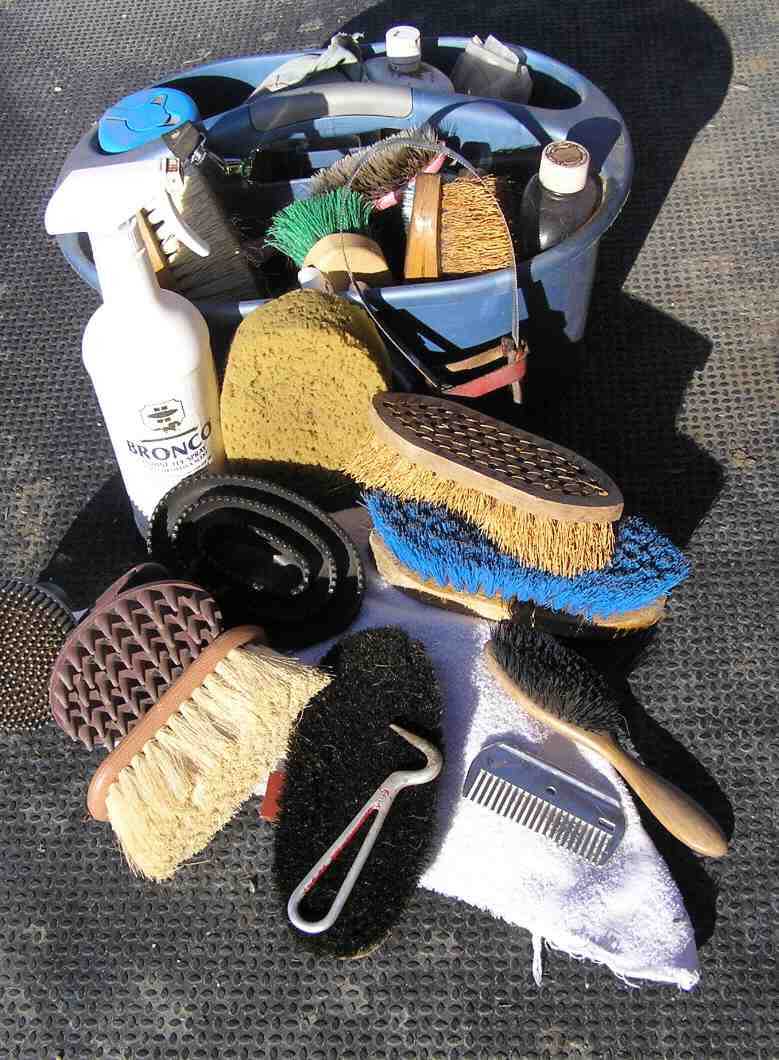
- Grooming: pick out a front hoof (one leg only) → comb the mane → use the curry comb in circles against the lie of the coat → brush
- Tacking up: saddle pad → half pad → saddle → girth (tightened alternately on each side to keep it balanced) → bridle
Candidates who find the saddle too heavy, or who are too short to fit the bridle easily, are told to ask the support staff for help. In the leading test, the candidate sets off at walk, goes round the turning point clockwise with it on their right, trots back once the horse is straight and facing the start line, and then returns to walk and halts. Examiners check that the walk is active, that the candidate walks level with the horse's shoulder, and that the spare rein is folded in the hand so it does not trail on the ground.
The riding course and oral questions
The candidate mounts from a mounting block while a helper holds the horse from the front, and both stirrup lengths are checked before starting. The arena measures 30 m by 40 m (20 m by 50 m is also allowed), and the course uses 16 traffic cones, six poles and one set of jump stands to ride under. The tasks are:
- Riding around obstacles on the course at walk
- Trotting straight over the middle of poles on the ground
- Trotting under a high obstacle (leaning the upper body forward)
- Halting in a marked zone, standing still for three seconds, then moving from walk to trot
- Dismounting in the correct order, bringing the reins over the head and praising the horse
The examiners focus on whether the rider can change direction with the reins, ride walk and rising trot, hold a basic position and the reins correctly, and use the aids (signals to the horse) with balance. Spurs and whips are not allowed, and there is no separate practice time before the Level 7 test. The oral questions cover behaviour shown by the horse's ears, eyes, lips, hind legs and tail, its eating habits, the main parts of the body such as the head, neck, withers and legs, what each grooming tool is for, walk and trot, the main and supporting aids, and the aids for upward and downward transitions.
Scoring and common misconceptions
The score sheet marks 21 items from 0 to 3. Candidates need at least 45 of 63 points in the practical test (including oral questions), at least 7 of 10 in the written test, and at least 52 of 73 overall. A fall, or failing to trot, means failing regardless of the score. Candidates get two attempts at each section.
The phrase "with a little help" appears several times on the Level 7 score sheet. The manual treats Level 7 as a way for candidates to get to know the scheme and says they may ask for help when they struggle. From Level 6, no help is given during the test, and anything the rider cannot do alone loses points.
A common misconception is that Level 7 requires canter. Riding all three gaits of walk, trot and canter is the Level 6 standard, and the Level 7 course is made up of walk and rising trot. Nor is it compulsory to start at Level 7. Candidates aged 18 or over on the date of application can go straight to Level 6, although the KRA recommends working up from Level 7. Details can change when the operating manual is revised, so candidates should check the latest notice before applying.