
Riding
Types of bit: snaffle and curb
· 5 min read
Bits fall into two families: snaffles, which pass the pull on the reins straight to the mouth, and curbs, which use the leverage of shanks to multiply it across the mouth, chin and poll. What decides the family is not the mouthpiece but whether there is leverage.
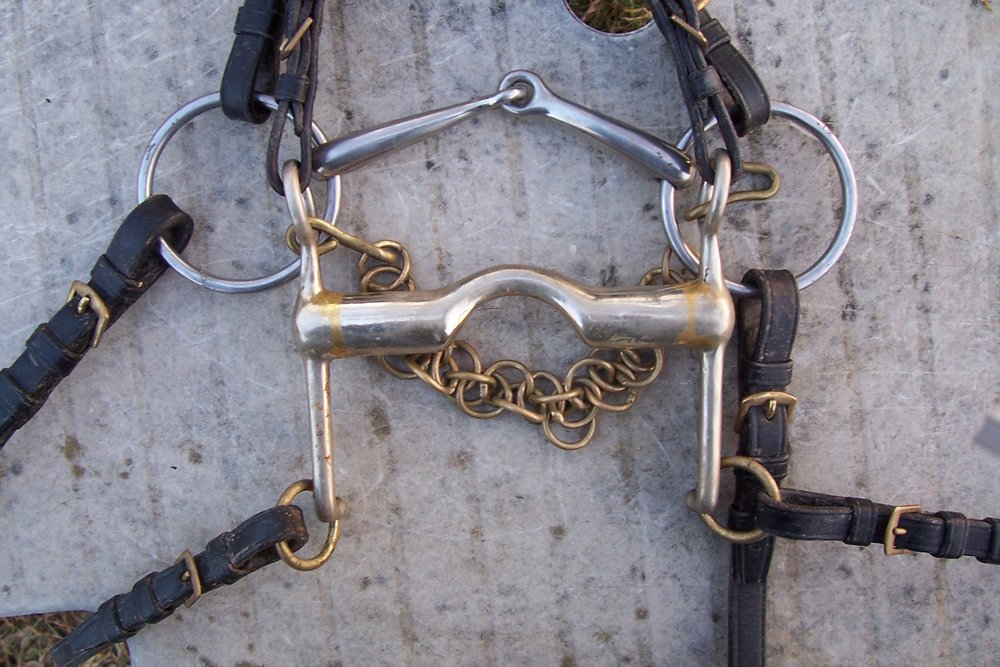
There are hundreds of bit designs, but by the way they work they fall into two broad families. A snaffle passes the pull on the reins straight to the mouth without leverage. A curb uses the leverage of the bars outside the mouth, the shanks, to multiply that pull and spread it across the mouth, chin and poll. What separates the two is not the shape of the mouthpiece inside the mouth but whether there is leverage. The UK animal welfare charity Blue Cross divides bits into five types by their mode of action, and says snaffles are the mildest and should be the most commonly used, while the other types are generally more severe.
The snaffle: what you put in is what the horse feels
A snaffle consists of a mouthpiece and two rings. The reins attach directly to the rings, so one unit of pull on the reins puts one unit of pressure on the mouth. The mouthpiece acts on the tongue and the bars (the toothless gums between the front teeth and the back teeth), and the lips and corners of the mouth feel pressure from both the mouthpiece and the rings. The most common mouthpiece has a single joint in the middle; when the reins are taken up it folds with a nutcracker action onto the tongue and bars. A double-jointed mouthpiece with a small link in the centre, the French mouth, reduces this nutcracker action.
The type of ring also changes how the bit feels.
- Loose ring: the ring slides through holes in the mouthpiece. It tends to encourage the horse to relax its jaw and chew the bit, but if the holes are large it can pinch the corners of the mouth.
- Eggbutt: the mouthpiece and rings are fixed and do not rotate, so the bit does not pinch the lips.
- D-ring: the D-shaped ring keeps the bit steadier, and its straight sides help guide the horse sideways.
- Full cheek: long arms extend above and below the lips, stopping the bit sliding through the mouth and adding a lateral guiding effect.
The curb: multiplying the pull with shanks
A curb bit has a mouthpiece, a shank on each side and a curb chain that runs under the jaw. Each shank is divided into an upper part above the mouthpiece, where the bridle cheekpiece attaches, and a lower part below it, where the rein attaches. When the reins are taken up, the lower shank rotates back and the upper part rotates forward, so the curb chain attached to it tightens in the hollow under the chin, the chin groove. Once the chain meets the jaw it acts as a fulcrum, pressing the mouthpiece down onto the bars, while pressure also reaches the poll through the bridle.
The longer the shank, the more pressure the same pull on the reins creates. In an example given by Wikipedia, a standard curb with a 1.5-inch (about 3.8 cm) upper shank and a 4.5-inch (about 11.4 cm) lower shank produces 3 pounds of pressure on the chin groove and 4 pounds on the mouth for every pound on the reins. Shanks range from just over 2 inches to more than 5 inches, and most horse show disciplines do not allow an overall shank length of more than 8.5 inches.
How tightly the curb chain is fastened governs how the bit works. The University of Missouri Extension guide advises adjusting it so that the shank rotates about 45 degrees before the chain begins to apply pressure. Too loose, and the bit turns too far and loses its action; too tight, and even the slightest pull on the reins brings immediate pressure, so the horse may become afraid of the bit, throw its head and resist. Curb mouthpieces are usually solid bars without joints, and a port, an upward arch in the centre, makes room for the tongue while putting more pressure on the bars.
Combination bits and competition rules
Some bits combine snaffle and curb action. A Pelham has both a ring at the mouthpiece and a ring at the end of the shank on a single bit, and is ridden with four reins to separate the two actions. A Kimblewick is a bit with a snaffle-like ring and a curb chain that applies a slight amount of leverage. A double bridle puts a small snaffle (the bradoon) and a curb bit in the mouth together so that each acts independently, and is ridden with four reins. A gag bit, in which the reins slide through the rings and draw the bit up in the mouth, is a severe bit that adds pressure on the lips and poll, and is not allowed in most show rings or on the racecourse.
Article 434 of the FEI Dressage Rules allows either a snaffle bridle or a double bridle at 1-star to 3-star international dressage events, at junior and young rider events and in classes for seven-year-old horses, and requires a snaffle bridle at pony and children's events and in classes for five- and six-year-old horses. It also forbids attaching a lunge line to the curb when lunging, the exercise of working a horse in a circle on a long line. The 2026 rulebook carries a note that a proposal to stop allowing the double bridle at junior events from 2027 is under consideration.
Common misconceptions and points to watch
The most common misconception is that any bit with a jointed mouthpiece is a snaffle. A bit with a jointed mouthpiece and shanks uses leverage, so it belongs to the curb family. Wikipedia notes that such bits are sometimes sold as "cowboy snaffles", but that the nutcracker action combined with leverage actually makes them harsher than a curb with a simple solid mouthpiece.
The idea that a snaffle is always mild is also wrong. The thinner or rougher the mouthpiece, such as twisted wire, the more the pressure is concentrated and the more severe the bit becomes, and a snaffle used harshly can damage a horse's mouth. Blue Cross warns that in the wrong hands any bit can cause a horse great pain, and that putting a stronger bit on a horse to hold it can make the horse go sideways, go backwards or rear.
With a curb, the noseband needs attention too. The Missouri guide says a horse wearing a curb must be able to open its mouth to relieve pressure, so the noseband should not be too tight, and a dropped noseband, which keeps the mouth shut, should never be used with a curb. Which bit suits a horse depends on the shape of its mouth and its stage of training, so it is safest to talk to an experienced instructor before changing bits.