
Riding
Why the sitting trot is hard to ride
· 5 min read
The horse's body rises and falls on every trot beat, and in sitting trot the rider must absorb it through the pelvis and lower back without leaving the saddle. Loose joints and staying in time with the horse matter more than holding on, and research suggests this takes long practice.
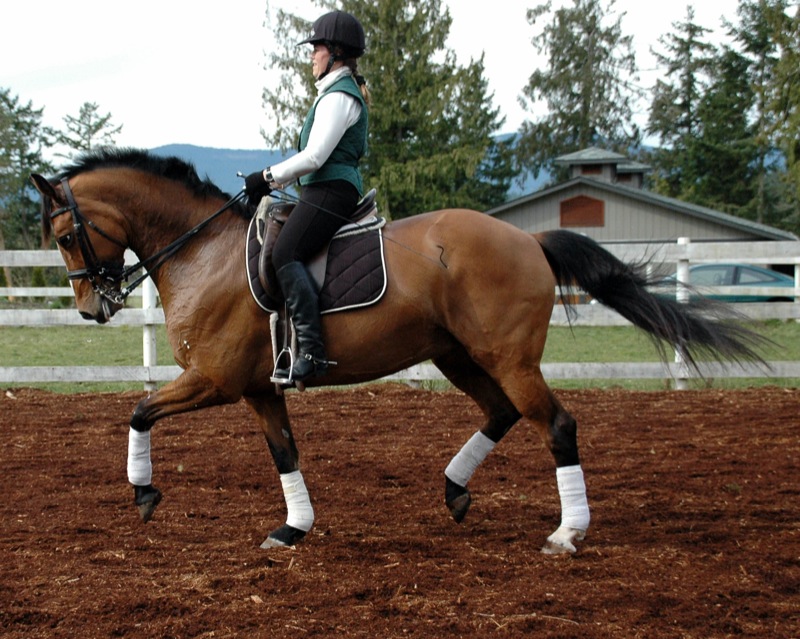
In the sitting trot, the rider keeps their seat in the saddle throughout the trot and follows the horse's movement. At the trot, the horse's body drops and springs up again on every beat, so the rider has to absorb that bounce through the pelvis, lower back and hips. A stiff body is bounced straight out of the saddle, and sitting well depends first on loose joints and the ability to stay in time with the horse, more than on strength. In research, too, this timing was what separated expert riders from novices.
Why the trot bounces
The trot is a two-beat gait in which diagonal pairs of legs take turns on the ground, with a moment between beats when all four feet are off the ground, called the suspension phase. The Wikipedia article on the trot explains that the horse's body drops slightly between beats and bounces up again when the next pair of legs strikes the ground. Each time, the rider is thrown upwards and meets the horse's back with some force on the way down.
A review published in the journal Animals in 2023 by Hilary Clayton of the Michigan State University College of Veterinary Medicine and colleagues describes this in more detail. The horse's back is highest around the start of suspension, and the rider keeps moving upwards briefly after that, taking weight off the horse's back. The horse then comes down and reaches its lowest point in the middle of the diagonal stance phase, but it is already starting to rise again when the rider's seat sinks deepest into the saddle. The force from the saddle that pushes the descending rider back up is about twice the rider's body weight. In sitting trot there are two such force peaks per stride, and during suspension the forces on the saddle and stirrups drop to zero, although this is hard to see from outside.
What happens in the rider's body
Wikipedia explains that in sitting trot the lower back and stomach move slightly forward and back while the hips follow both the up-and-down and side-to-side motion of the horse. The rider absorbs the impact by relaxing the hips, stomach, lower back and legs, keeps the upper body upright and quiet, and keeps the hands steady. The lower legs stay relaxed and come into play only to give a leg aid, a signal the rider gives the horse with the legs.
According to the same review, when the horse's trunk pitches nose-down early in the diagonal stance phase, the rider's pelvis tilts forward by 13 to 15 degrees and the upper body tips back by about 11 degrees to resist the forward pull. This hollows the rider's lower back. In the second half, the pelvis tilts back and the upper body forward, the curve of the lower back flattens, and the rider follows the horse as it moves forward again. Because stirrup forces are low in sitting trot, the legs have limited influence, and the researchers consider the lower back likely to be the key to how the rider moves.
Repeating this on every stride takes fitness. Wikipedia notes that sitting the trot is very tiring for riders who have not built up their stomach and back muscles, or on a powerful horse with a big trot. Even experienced riders tire when sitting a powerful extended trot for long periods, and a fast trot such as a harness racing trot is virtually impossible to sit. By contrast, the slow jog of western riding has less bounce and is easy to sit.
Expert and novice riders
A study published in the Journal of Motor Behavior in 2005 put one expert dressage rider and one hobby rider who occasionally rode lower-level dressage on the same horse and measured eight sitting trot trials for each. The expert's movements stayed in phase with the horse throughout, while the hobby rider's timing slipped out of phase from time to time. In the hobby rider, the delay grew from the shoulder towards the wrist, and it began at the lowest point, when the horse extends its legs. When the expert rode, the oscillations of the horse's trunk were also more regular. The researchers concluded that strong synchrony comes only after extended practice. It should be kept in mind that the study compared only two riders.
The Animals review also describes other studies.
- Expert riders keep their elbows more flexed in sitting trot, and their knees bend and straighten through a smaller range.
- The shoulders and elbows move together so that the wrist stays within 15 mm of the same position relative to the bit on each stride.
- Novices move the left elbow and left knee through a larger range, and their heads tilt further forward.
- In a test of tilting only the pelvis forward and back while sitting on a Swiss ball, riders with major compensating movements, such as using the lower back or leaning, leaned further forward on the horse, were more asymmetrical between left and right, and were more out of phase with the horse.
Common misunderstandings and points for practice
The most common misunderstanding is that holding on tighter reduces the bounce. US horse trainer Julie Goodnight lists tense muscles and locked joints, a closed pelvis and gripping with the knees as the most common faults in riders learning to sit the trot. Tensing a muscle locks a joint somewhere, and locked joints lead to bouncing. Gripping with the knees closes the pelvis and brings the heels up, so the rider pushes on the stirrups, which pushes them up and out of the saddle. She suggests these exercises.
- Sit in a correct position with ear, shoulder, hip and heel in line and your weight on your two seat bones.
- Ride without stirrups to break the habit of pushing on them and lifting out of the saddle. This is best done in a safe arena with an instructor watching.
- Off the horse, do exercises that train the abdominal muscles, such as Pilates or yoga.
If the bouncing continues, not forcing the sitting trot is better for the horse as well. Wikipedia notes that when a rider who cannot sit the trot keeps landing on the horse's back, the horse is uncomfortable too and will hollow its back and stiffen its movement, and it recommends the rising trot in that case. The Animals review explains that peak loads in sitting trot are relatively high, so for horses in rehabilitation, young horses and warm-ups, a position with the seat lifted out of the saddle and the weight in the stirrups spreads the load more evenly.
The sitting trot is still well worth learning. It is required in western show riding and preferred in dressage, especially at the upper levels, and because the rider can use the seat and weight to ask for transitions, turns and more or less impulsion, it gives the most control of the three ways of riding the trot. If the horse keeps stiffening its back or seems uncomfortable during sitting trot, it is safest to consult a veterinarian.
Sources
- Wikipedia (English), Trot
- Animals, Clayton et al., Riders' Effects on Horses: Biomechanical Principles with Examples from the Literature (15 December 2023)
- Journal of Motor Behavior, Lagarde et al., Coordination Dynamics of the Horse~Rider System (November 2005)
- Julie Goodnight Academy, Riding Skills: Sitting Trot (12 May 2014)