
Riding
How to set your stirrup length
· 4 min read
Start with stirrups that reach your ankle bone when your legs hang free, then adjust one hole at a time for the discipline, the horse's build and your own experience. There is no single correct length, only a starting point.
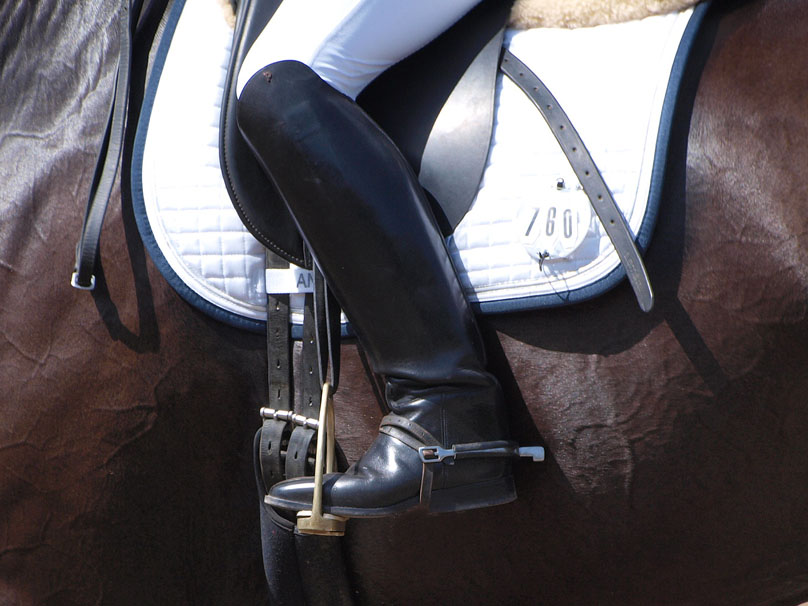
The stirrup is the footrest the rider stands on, and its length is set with the holes in the stirrup leather that hangs from the saddle. There is no single correct stirrup length. The American magazine Horse Illustrated describes it as a very personal choice that varies widely between riders. The usual starting point is much the same, though. Once mounted, take your feet out of the stirrups and let your legs hang: the bottom of the stirrup iron should be around your ankle bone. From there, you adjust for the discipline, the horse's build and your own level of experience.
The starting point: arm length and ankle bone
The rider education site Equiculture describes two rough methods. Before mounting, put the knuckles of one hand on the stirrup bar (the metal bar under the saddle skirt that the stirrup leather hangs from) and pull the iron along your arm with the other hand. If the bottom of the iron reaches your armpit, the length is about right. Once mounted, take your feet out, let your legs hang and check whether the bottom of the iron is level with your ankle bone.
The same site says both methods only give a ballpark figure. For a more accurate check, stand in the stirrups while the horse is standing or walking, and let your heels drop slightly. If your seat just clears the pommel (the raised front of the saddle), the length is about right. Check again once you start to trot. For flatwork, it says the thigh should sit at about 45 degrees from vertical, or a little less, around 40 degrees, for a very experienced rider.
Too long and too short
According to Equiculture, stirrups that are too long are far more common than stirrups that are too short, and one reason it gives is the wish to make the legs look as long as possible. With long stirrups, the seat cannot clear the pommel in rising trot, and the heels come up as the seat rises. Once the heel is higher than the toe, the rider is effectively on tiptoe on the balls of the feet. The lower leg stops doing its job, balance is lost more easily and the rider tends to rely on the reins. In sitting trot and canter, the irons clatter around on the feet or are lost altogether.
If the stirrups are too short, the rider tends to sit further back in the saddle, putting weight on the weaker part of the horse's back, further from the withers. The rider rises too high in rising trot, which raises the centre of gravity, and the leg muscles and joints tire quickly. The same site explains that short stirrups soon become uncomfortable, so riders often correct them on their own. If you think your stirrups are too long, it suggests shortening them one hole at a time and comparing how stable your lower leg feels.
Length by discipline and by horse
Horse Illustrated names the most commonly cited guideline for jumping small fences as the bottom of the iron at the middle of the ankle bone. If you are focusing on flatwork, go a little longer, to just below the ankle bone. If you jump bigger fences or find yourself reaching for the stirrups over a jump, go shorter, to the top of the ankle bone.
At the long extreme are high-level dressage riders, who rarely rise to the trot. They let their legs hang almost as long as they would without stirrups. At the short extreme are event riders on cross-country courses with big fences. They need to stay off the horse's back for long stretches of fast galloping, which is why their saddles have very forward knee rolls.
The same magazine points out that rules such as "go up one or two holes for jumping" are of little use. The distance between holes differs from one leather to another, and a short rider and a tall rider may need anything from one hole to six to reach jumping length. The horse's build matters too. On a very round-barrelled horse, slightly longer stirrups can help the legs feel wrapped around the barrel. On a narrow horse, slightly shorter stirrups may feel better.
What research shows
A 2018 study in the journal Comparative Exercise Physiology asked 10 novice and 10 experienced riders to choose their own flatwork length using unnumbered stirrup leathers. The experienced riders chose longer stirrups relative to their leg length, and their knee angle averaged 118 degrees, compared with 109 degrees for the novices. The researchers interpreted this as the result of an independent seat, meaning the ability to move the legs independently of the pelvis.
A 2022 study in the journal PeerJ compared 11 show jumping riders with their stirrups shortened or lengthened by 60 mm from a baseline length that put the knee at 90 degrees. Shorter stirrups improved shock absorption in the rider's body at canter and increased the force on the stirrups. Longer stirrups reduced the force on the reins. The researchers summarised that lengthening the stirrups shifts weight from the stirrups to the saddle, and shortening them does the opposite. Even so, they concluded that no length is better than another and that riders responded very differently, so individual adjustment matters. The paper also cites earlier work suggesting that short stirrups close the hip angle, tilt the pelvis back and can add strain on the lower back.
Sources
- Horse Illustrated, Ask the Expert: Stirrup Length for Flatwork and Jumping (2015)
- Equiculture, Your stirrup length - what is too long, too short, just right? (2021)
- Andrews-Rudd et al., Comparison of stirrup lengths chosen for flatwork by novice and experienced riders (Comparative Exercise Physiology, 2018)
- Elmeua González and Šarabon, Effects of saddle tilt and stirrup length on the kinetics of horseback riders (PeerJ, 2022)