
Riding
The correct seat: the ear, shoulder, hip and heel line
· 5 min read
In the correct seat, the rider's ear, shoulder, hip joint and heel sit on one vertical line when seen from the side. The line is about balance over the horse's centre of gravity, not looks, and research suggests it should be judged in motion rather than as a still pose.
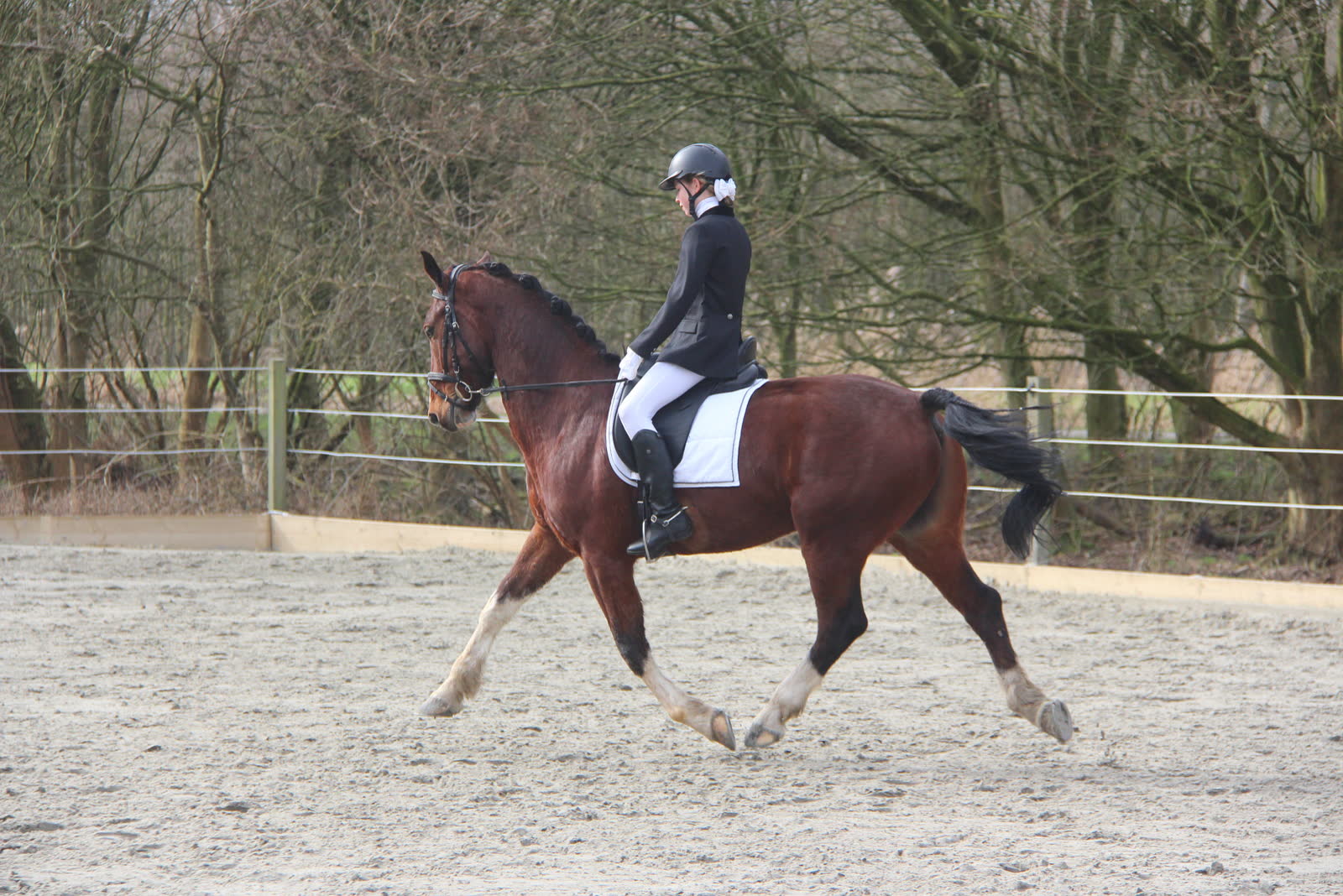
The seat is the way a rider sits on the horse. The correct seat, as it is usually taught, is one in which the rider's ear, shoulder, hip joint and heel fall on a single vertical line when seen from the side. A 2015 paper by British researchers quotes the British Horse Society (BHS): in the correct position, two straight lines can be seen from the ground, and the first runs from the rider's ear through the shoulder and hip to the heel. The line is a standard for balance, not for appearance. More recent studies, however, suggest treating it as a reference the rider keeps returning to while moving, rather than as a fixed correct answer.
Why a vertical line
Writing for the American Quarter Horse Association (AQHA), riding instructor Julie Goodnight explains that this alignment is about balance for both rider and horse. Think of carrying someone piggyback: if they are lined up with your centre of gravity, staying balanced is easy, and if they lean forward or back, it gets harder. Sitting correctly puts the rider just above and slightly behind the horse's centre of gravity. The skeleton's alignment, not muscle strength, keeps the rider upright, and relaxed joints absorb shock and follow the horse smoothly. A rider who relies on muscle ends up gripping, and tight muscles lock the joints so the rider can no longer follow the horse's movement.
Goodnight says the basic alignment does not change even when stirrup length or saddle type does. It is the same in western and English riding because the horse is the common denominator. Horse&Rider magazine puts it this way: the legs should hang down from the hips in a position that would let the rider stand on their own two feet if the horse suddenly disappeared. The same article explains that the horse's centre of gravity lies just behind the shoulder and below the withers (the raised point where the neck meets the back).
Four places the line breaks
The AQHA article goes through the problems that commonly appear at each point on the line.
- Ear: looking down brings the ear in front of the shoulder and tends to put the horse heavier on the forehand. Look where you are going, not at the horse's head. Jutting the chin and tensing the neck while concentrating also changes your balance.
- Shoulder: tension collected in the shoulders makes the hands bounce. Rather than forcing the shoulders back, lift the sternum and sit tall.
- Hip: the most common problem is the shoulders coming in front of the hips. This closes the hip joint, which is the biggest shock absorber in the rider's body. A forward-going horse may take a forward lean as a cue to speed up, and if the rider then pulls on the reins, the body tips further forward and the lower leg slides back and squeezes the horse.
- Heel: the lower leg creeping forward is the most common fault. It is comfortable, and many saddles are built with the stirrups hanging forward. If you glance down at your knee and see your toe in front of it, your leg is too far forward. Pushing the heel down too hard actually drives the leg forward and stiffens the joints.
Horse&Rider calls the leg-forward position the "chair seat". When the legs slide forward, the rider's weight shifts back and presses down into the horse's back. The article lists the causes as saddles whose stirrups hang in front of the seat's centre, stirrups that are too long, and the habit of pushing the heels down too far and leaning back against the rear of the saddle.
How to check yourself
Horse&Rider describes a simple method. Hold the reins in one hand, hold the front of the saddle with the other, stand up in the stirrups and notice where the stirrups and legs are. Once you can balance without holding on, sit back down onto your seat bones (the bones of the seat that touch the saddle), sit up straight and let your legs rest softly against the horse's sides. Because it is hard to tell from the saddle whether the line is straight, ask someone to watch from the side or film yourself. The AQHA article also notes that video helps when no instructor is available, and that exercise which builds body alignment and core strength, such as yoga or Pilates, carries over into position in the saddle.
What the research shows about its limits
Holding the line is harder than it sounds. A study in a 2014 scientific report (DCA Report) published by Aarhus University in Denmark seated 30 riders on a dressage saddle placed on a saddle horse, asked them only to sit as they would in a dressage test, and photographed them from the side. The study left out the ear and measured whether the shoulder, hip joint and ankle lined up with a vertical line through the hip joint. All 30 riders had their ankle in front of the line, and 27 (90%) had their shoulder behind it. There was no difference between the 15 novice or non-competitive riders and the 15 advanced or competitive riders. The mean distance from the line was 5.47 cm and 4.02 cm for the shoulder, and 8.71 cm and 8.68 cm for the ankle. The researchers suggested the saddle may have influenced position more than experience did.
Position can improve with training. A study published in 2015 in the Journal of Sports Science put 16 novice riders who did almost no exercise through a fitness programme done off the horse. The seven riders on rider-specific training followed it for eight weeks, and the nine on traditional neuromuscular training for five weeks. Both groups showed a significant reduction in how far they deviated from the ear, shoulder, hip and heel line, and the deviation also differed by gait across walk, rising trot and sitting trot.
At Hartpury University in England, Celeste Wilkins measured the pelvic tilt of dressage riders on a riding simulator. Mean pelvic tilt in walk, trot and canter was related across those gaits but not to pelvic tilt at halt, and competition level had no clear effect on mean pelvic tilt. Riders used their pelvis in their own individual ways from gait to gait. Wilkins says riders should be assessed in motion rather than from a single still image. The ear, shoulder, hip and heel line is better understood not as a pose to lock in place, but as a reference line the body keeps coming back to while the horse moves.
Sources
- American Quarter Horse Association (AQHA), Julie Goodnight, Body Position for Horseback Riding: Basic Principles (2019)
- Horse&Rider, Perfect Position, Perfect Ride
- Tabor and Randle, An investigation into the ability of riders to obtain an ideal dressage position (DCA Report 44, 2014)
- Boden and Randle, The Effects of Traditional Neuromuscular Training and Rider Specific Training on Novice Horse-Rider Position (Journal of Sports Science, 2015)
- Hartpury University, Rider posture and its influence on synchronisation