
Riding
What the half-halt really means
· 5 min read
The half-halt is not half of a halt. The rider applies driving and restraining aids in quick succession and then releases at once, so the horse shifts its balance back towards the hindquarters. The key is to keep it brief and always let go.
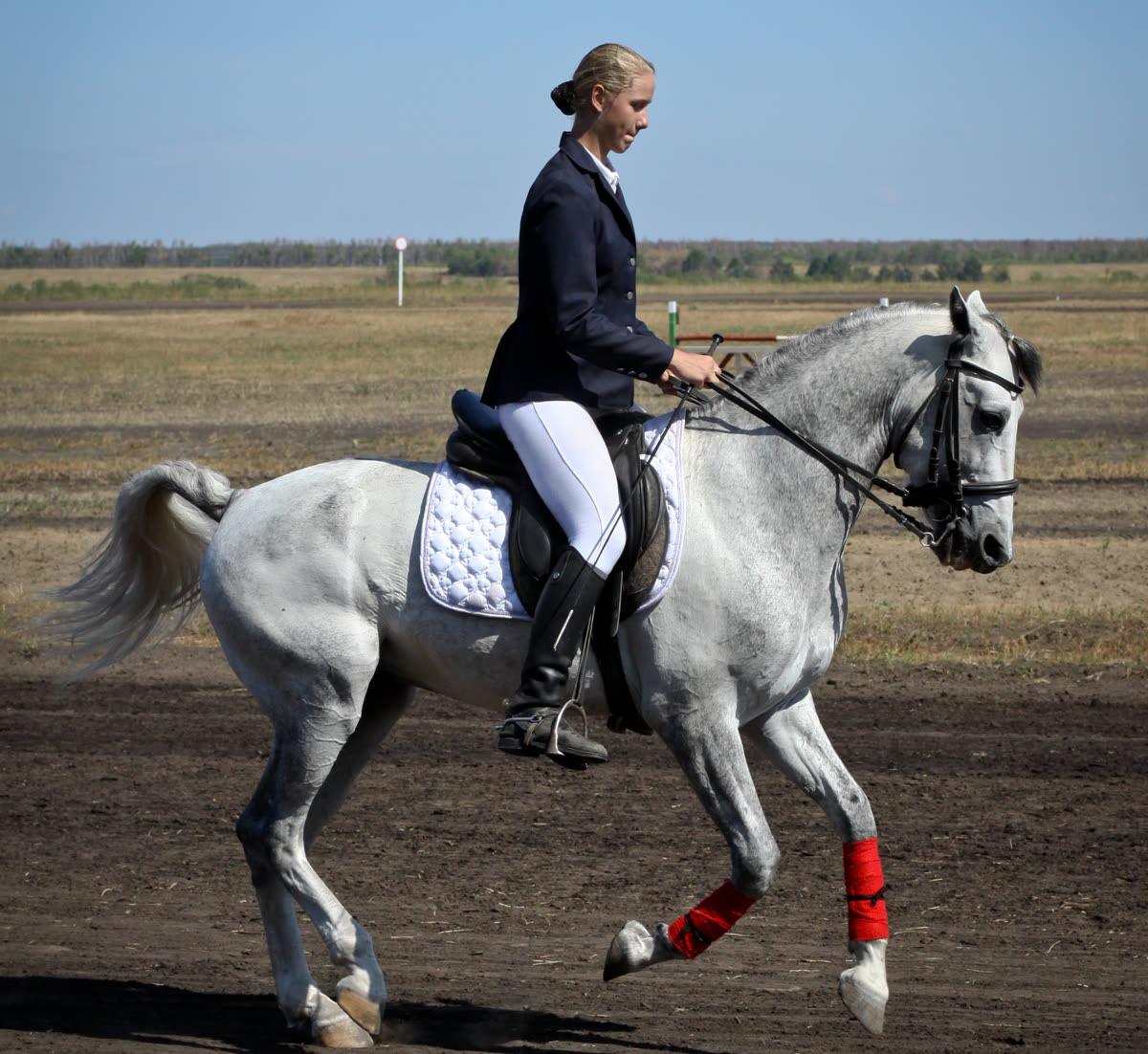
The half-halt is a riding aid (a signal from rider to horse) in which the rider applies driving and restraining aids in quick succession and then releases them straight away. The name suggests stopping the horse halfway, but slowing down is not the goal. The aim is to shift a little of the horse's weight from the forehand to the hindquarters so it rebalances, and to warn it that the next request is coming. It is used most in dressage, but riders use it in the same way in show jumping and everyday riding.
Not half of a halt
In an article for the United States Dressage Federation (USDF), trainer Jennifer Baumert explains that, despite its name, the half-halt is not half of a halt. It organises the horse's energy rather than stopping it. Borrowing a phrase from Olympian Courtney Dye, she calls it a "half-go". The US dressage trainer Jane Savoie, writing in the British magazine Horse & Hound, says the same: there is no stopping in a half-halt, and every half-halt should contain the surge of power from behind.
Wikipedia sums up what the half-halt is used for:
- It rebalances the horse so it carries slightly more weight on the hindquarters and less on the forehand.
- It calls the horse's attention back to the rider before a transition between or within gaits, a turn, a difficult movement or a jump.
- It helps a horse that leans on the bit take a lighter contact.
- Repeated half-halts are used to collect a gait (to shorten the stride and bring the horse's body together).
A half-halt on its own should not make the horse change gait. If the horse drops from trot to walk after a half-halt, the rider has ridden a downward transition, not a half-halt.
Drive, hold for a moment, release
Baumert breaks the half-halt into three parts. First, a driving aid such as the leg creates energy. As the horse goes forward into the rein contact, the rider's hand, which normally follows the horse's movement, stops and stays still for a moment. Then the rider releases at once and goes back to following the movement, so the horse can go freely forward in its improved balance. The whole process takes one stride or even less.
Wikipedia also describes the opposite order. The rider first applies the restraining aids, asking the horse to "almost halt" and bring its hind legs under its body, and then immediately applies the driving aids to keep the gait going. Either way, the aids are never held for long. In dressage, the main restraining aid is usually bracing the lower back so the hips briefly stop following the horse, with a little added rein pressure, and very well-trained horses respond to a simple deepening of the seat. When jumping in two-point position (with the seat lifted out of the saddle), the rider restrains by sinking the weight into the heels and bringing the shoulders more upright.
When to give it
Wikipedia quotes dressage trainer Thomas Ritter, who says the best moment for a half-halt is when the hind leg it is meant to control touches the ground. When the hind leg first lands in front of the body, it carries weight and flexes, and that is the moment for the half-halt. If the rider half-halts after the leg has passed the vertical and started to push off, the horse braces and goes against or evades the bit. If the rider half-halts while the leg is in the air, the stride shortens and the hind leg cannot step under the body. Baumert also writes that the shift of balance towards the hindquarters can only happen while the hind leg is on the ground.
In practice, Baumert says she half-halts in every corner and before every movement and transition. Skilled riders half-halt continually, before the horse can really lose its balance, so onlookers can barely see it. After a good half-halt, the forehand feels raised, as if there is more horse in front of the rider than behind, and the gait becomes more elevated and expressive rather than flatter.
Common mistakes and different teaching
The most common mistake is failing to release. Baumert notes that when a half-halt does not seem to work, it is human nature to simply hold on, but the horse then leans on the bit and the rider ends up carrying the horse with the hands. Wikipedia likewise says that holding the aids too long makes the horse lean on the bit, tighten its back and finally ignore the aids, and that yielding the aids matters as much as applying them. If the horse is already leaning on the rider's hands and pulling, a half-halt only pulls on the front end, so the horse slows down, shortens its neck, or both. In that case Baumert suggests real downward transitions, such as walk to halt or trot to walk, or a little lateral work to get the hind legs working again first. If one half-halt does not get through, the rider gives several in a row.
Trainers do not all describe it the same way. Baumert and Wikipedia say a half-halt is over within one stride, but Savoie describes a "connecting half-halt", used to put the horse on the bit, that lasts about three seconds. The rider closes both legs to create power, closes the outside hand in a fist to contain it, gives three small squeezes and releases on the inside rein to keep the neck straight, and after three seconds softens everything. Savoie explains that the confusion comes from the many variations on one basic half-halt, since the seat, legs and hands can be used in different ways and the duration and strength can vary. How strong the aids are also depends greatly on the horse's training, temperament and balance.
A study that measured the reins
A study by Agneta Egenvall and colleagues, published in the journal Animals in 2019, measured rein tension while six professional riders trained three of their own horses each, 18 horses in all, as they normally would. Across 496 gait transitions, rein tension in the second before a transition was generally higher than the usual tension for the same gait. The researchers noted that riding manuals recommend making a transition through several half-halts with releases in between, but in their measurements no clear release during the transitions showed up in the rein tension curves. Because tension varied widely between riders and horses, they concluded that making transitions with a lighter contact is a realistic training goal. The core principle of the half-halt, a brief aid followed by a release, is not easy even for professional riders.
Sources
- Wikipedia, Half-halt
- United States Dressage Federation (USDF), USDF Connection, November 2015, Dressage Puzzlers: half-halts (Jennifer Baumert)
- Horse & Hound, The half halt: a simple guide on how to ride it (14 January 2022)
- Egenvall et al., Rein Tension in Transitions and Halts during Equestrian Dressage Training (Animals, 2019)