
Riding
The dressage arena letters A, K, E, H, C, M, B and F
· 4 min read
The letters around a dressage arena are coordinates that show where each movement starts and ends. In the small arena they run clockwise from the entrance at A: A, K, E, H, C, M, B, F. A transition "at the letter" means when the horse's shoulder is level with it.
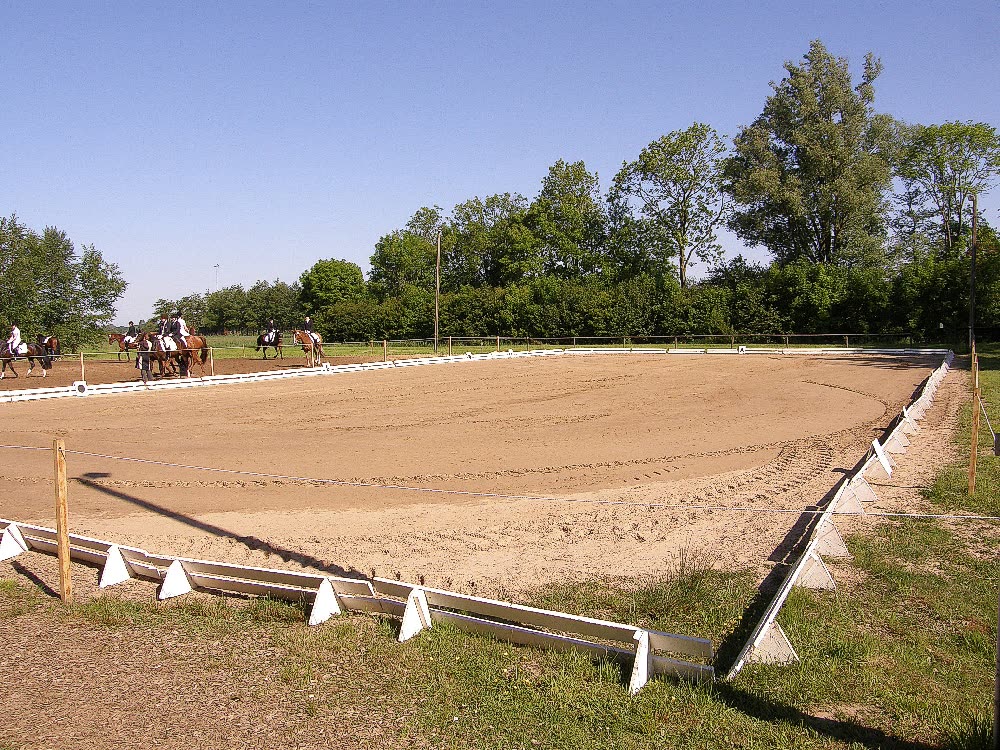
The letters placed around a dressage arena, such as A, K, E, H, C, M, B and F, are coordinates. In a test (a set sequence of movements), they tell the rider where each movement begins and ends. Test sheets write every movement in terms of letters, for example "trot at A" or "20-metre circle at C". Riders therefore learn the order and spacing of the letters, and judges use them as the reference for accuracy.
Two sizes and their letters
According to Wikipedia, there are two sizes of dressage arena: the small arena (20 by 40 m) and the standard arena (20 by 60 m). The small arena is used for lower-level dressage competitions and for the dressage phase of lower-level eventing. The standard arena is used for both pure dressage and eventing.
- Small arena: clockwise from the entrance at A, the letters are A-K-E-H-C-M-B-F. Along the centre line from A are D-X-G, with X exactly halfway between E and B.
- Standard arena: the outside letters are A-K-V-E-S-H-C-M-R-B-P-F, and the centre line letters are D-L-X-I-G. On the long sides, the letters nearest the corners are 6 m in from the corners, and the long-side letters are 12 m apart.
There are also two quarter lines between the centre line and the long sides, but in competition they are rarely used except in freestyle (a test the rider designs and rides to music). English-speaking riders remember the small-arena letters with the phrase "All King Edwards Horses Can Make Big Fences".
What the international rules require
Article 411 of the FEI Dressage Rules sets the arena for international competition at 60 m long and 20 m wide. It must be flat and level and mainly sand. The difference in height must not exceed 60 cm across the diagonal or along the length, or 20 cm along the short side. The arena is enclosed by a low white fence about 30 cm high, and the fence at A must open and close easily. The entrance is at least 2 m wide and stays closed until the judge at C gives the starting signal.
The letters stand about 50 cm outside the fence, and a marker must also be placed on the fence itself, level with each letter. Advertising is not allowed on the letters or their holders. The rules fix five judging positions. On the short side sit the judge at C, on the line of the centre line, and the judges at M and H, 2.5 m inside the line of the long sides. Beside the long sides sit the judges at B and E. All are 3 to 5 m from the arena at outdoor events. When seven judges are used, two more sit on the short side opposite C, and Wikipedia calls them the judges at K and F. Judges are named after the nearest letter, but only those at C, B and E sit directly behind their letter.
When exactly is "at the letter"?
Kathy Rowse, a judge writing for the United States Dressage Federation (USDF), explains that when a test asks for a transition at a letter, it means the moment the horse's shoulder is level with the letter. If the rider waits until the horse reaches the letter before asking, the transition will be late, so the rider must prepare before the letter.
How accurate the rider must be depends on the level. Judge Aviva Nebesky says that at Training Level (a lower US level), any part of the horse from nose to hindquarters on the letter is acceptable, but at FEI level the transition should happen right as the horse reaches the letter. For a halt at X, the horse's nose or tail at X is close enough at Introductory or Training Level, but at Second Level X should be somewhere between the front and hind legs.
Circles, corners and common mistakes
Unlike transitions, figures must be in the right place at every level. Nebesky explains that in a 20 by 40 m arena, a 20-metre circle at C should cross the centre line between E and B, and a diagonal should start at F and reach H at the other end with the horse's head, neck and shoulders. Rowse lists the mistakes judges often see: circles that shrink to 18 m at the ends (A and C), circles that grow to 24 m in the middle (B and E), and egg-shaped circles. She suggests marking the circle points with cones for practice. Corners are not scored on their own, but they prepare the next movement, and cutting a corner spoils the next transition. According to Rowse, US Equestrian (USEF) rules say corners should be ridden as one quarter of a small circle (volte) suited to the level.
Nobody knows where the letters came from
There is no settled answer to why these letters were chosen. The British magazine Horse & Hound reports that arena letters were formally introduced into competition at the 1932 Los Angeles Olympic Games, in a 60 by 20 m arena. The best-known theory dates them to the 18th-century kingdom of Prussia, where grooms are said to have waited with horses beside letters that stood for their masters' ranks: K for Kaiser (emperor), R for Ritter (knight), F for Fürst (prince) and so on. That theory, however, cannot explain A, X and C. Other theories say the letters were the initials of horses in the stable yard of William Cavendish, the 17th-century first Duke of Newcastle, or that 20th-century German cavalry officers introduced them. Wikipedia also says the reason for the choice of letters is a matter of speculation. The origin may be unclear, but the purpose is clear: the letters give riders and judges a shared set of reference points.
Sources
- Wikipedia, Dressage (Arena and Judges sections)
- International Federation for Equestrian Sports (FEI), Dressage Rules, 26th edition (updates effective 1 January 2026), Article 411 Arena
- United States Dressage Federation (USDF), USDF Connection, September 2016, Geometry Class (Kathy Rowse)
- Dressage Today, Ask the L: Transition Accuracy Expectations Through the Levels (Aviva Nebesky, 3 October 2025)
- Horse & Hound, Ask H&H: dressage letter markers (10 December 2008)