
Riding
How dressage is scored
· 4 min read
Dressage judges give each movement a mark from 0 to 10. Key movements are multiplied by a coefficient, the marks are added up and turned into a percentage of the maximum. The final score is the average of the judges' percentages, and errors of course are deducted from it.
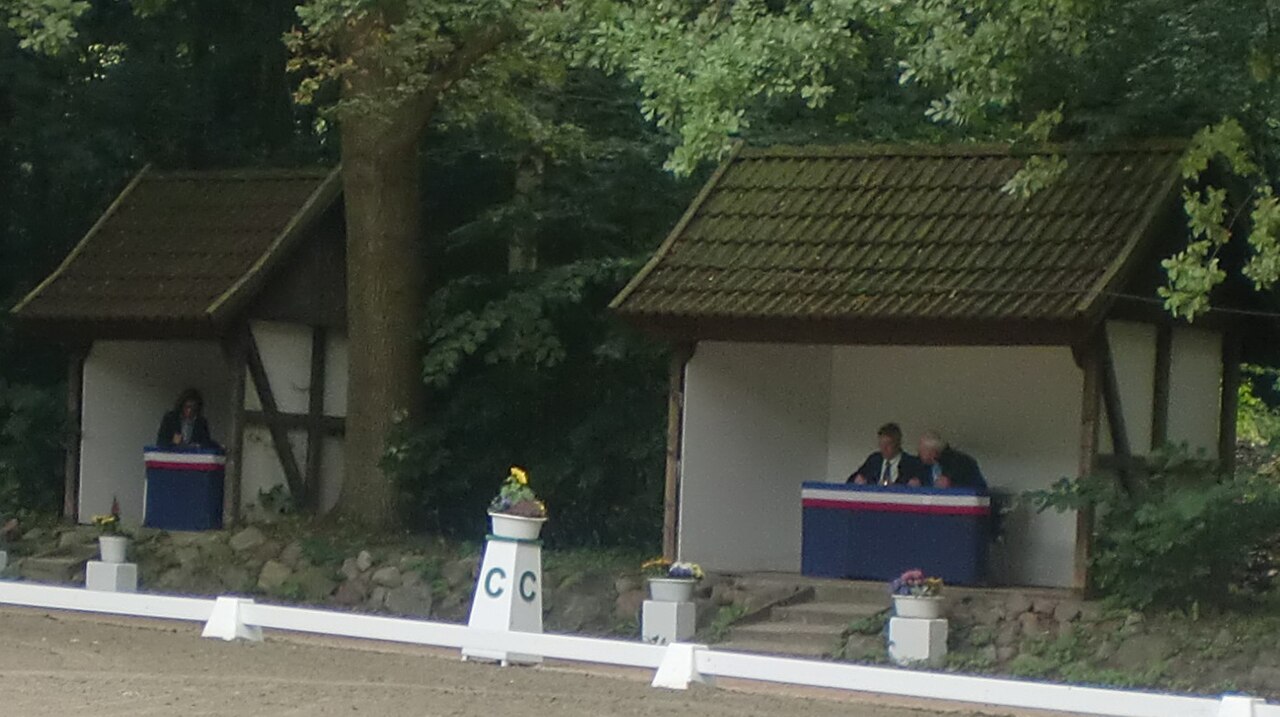
In dressage, riders do not compete head to head. Each one rides a set test (a fixed sequence of movements) and is judged against a common standard. Judges give each movement a mark from 0 to 10, multiply key movements by a coefficient (a weighting), add everything up and turn the total into a percentage of the maximum. The final result is the average of the judges' percentages, and errors of course or breaches of the rules are deducted from that percentage.
The scale from 0 to 10
Article 423 of the FEI Dressage Rules defines the marks: 10 excellent, 9 very good, 8 good, 7 fairly good, 6 satisfactory, 5 sufficient, 4 insufficient, 3 fairly bad, 2 bad, 1 very bad and 0 not executed. "Not executed" means that practically nothing of the required movement was shown. Judges may also use half marks from 0.5 to 9.5, and in freestyle tests (tests the rider designs and rides to music) the artistic marks can go down to 0.1.
The judge's sheet has a column for remarks next to each mark. Article 421 says remarks must be in English and strongly recommends giving reasons for marks of 5 and below. According to Wikipedia, a rider who scores 6 for every movement, or about 60% overall, would typically move up to the next level.
Coefficients and the collective mark
Not every movement carries the same weight. The rules allow the FEI to give certain difficult movements a coefficient, and Wikipedia explains that the coefficient is usually 2, which doubles the mark for that movement. After the ride, each judge also gives one collective mark. Under the current rules, it assesses the harmony between horse and rider and how well the training scale (the sequence of rhythm, suppleness, contact, impulsion, straightness and collection) is shown.
The FEI Dressage Judging Manual tells judges to keep the horse's welfare first. Minor mistakes are deducted from the mark the judge intended to give. Serious mistakes trigger a "firewall": the mark cannot be higher than 5. For example, if the horse's tongue is clearly hanging out to the side, that movement cannot score more than 5.
From marks to a percentage
Under Article 425, each judge's marks are multiplied by their coefficients and added up, then divided by the maximum shown on the test sheet and multiplied by 100. The Grand Prix test has a maximum of 460 points, so a judge's total of 368 points gives that judge a score of 80%. The final score is the sum of the judges' percentages divided by the number of judges, published to three decimal places.
In a freestyle, the technical and artistic totals are each turned into a percentage and then averaged. The Grand Prix Freestyle has a maximum of 200 points for technical marks and 200 for artistic marks. According to the manual, the five artistic marks are rhythm, energy and elasticity; harmony; choreography; degree of difficulty; and music and its interpretation.
If riders tie for the top three places in a standard test, the one with the higher median judge's score is placed ahead. In a freestyle, ties are broken by the artistic score, then the harmony mark, then the choreography mark. In team competition, the scores of each team's three best riders are added together.
Penalties for mistakes
Article 424 treats an "error of course", such as a wrong turn or a missed movement, and an "error of execution", such as rising trot instead of sitting trot, in the same way. The first error costs two percentage points per judge, and the second means elimination. In tests for young horses, children, ponies and juniors, the first error costs 0.5 percentage points, the second 1 percentage point, and the third means elimination. Entering the arena with a whip, entering before the bell, or repeatedly using the voice or clicking the tongue are technical faults, each costing 0.5 percentage points. If the judges do not notice an error, the rider gets the benefit of the doubt and is not penalised.
Keeping judges consistent
At upper-level competitions, up to seven judges sit at C, E, B, K, F, M and H. This lets faults that are hard to see from one position be caught from another angle. A three-member Judges Supervisory Panel (JSP) is mandatory at the Olympic Games, World and Continental Championships at Grand Prix level, and World Cup Finals (Article 442). The panel may correct definite technical mistakes and counting errors, but cannot set marks outside the range the judges gave. If one judge's final score differs by 5% or more from the average of the other judges, the panel may, by unanimous decision, change it to the next closest score.
Dressage in eventing is calculated differently. According to Wikipedia, the points earned are divided by the maximum, multiplied by 100 and subtracted from 100, so in eventing a lower dressage score is better.
Sources
- International Federation for Equestrian Sports (FEI), Dressage Rules, 26th edition (updates effective 1 January 2026), Articles 421, 423, 424, 425 and 442
- International Federation for Equestrian Sports (FEI), Dressage Judging Manual (effective 1 January 2024)
- Wikipedia, Dressage (Judges, Tests and Olympic sections)