
Riding
How penalties work in show jumping
· 4 min read
Most show jumping classes are scored under Table A. A knocked-down pole or a first refusal costs 4 penalties, each second over the time allowed costs 1, and a second refusal or a fall means elimination.
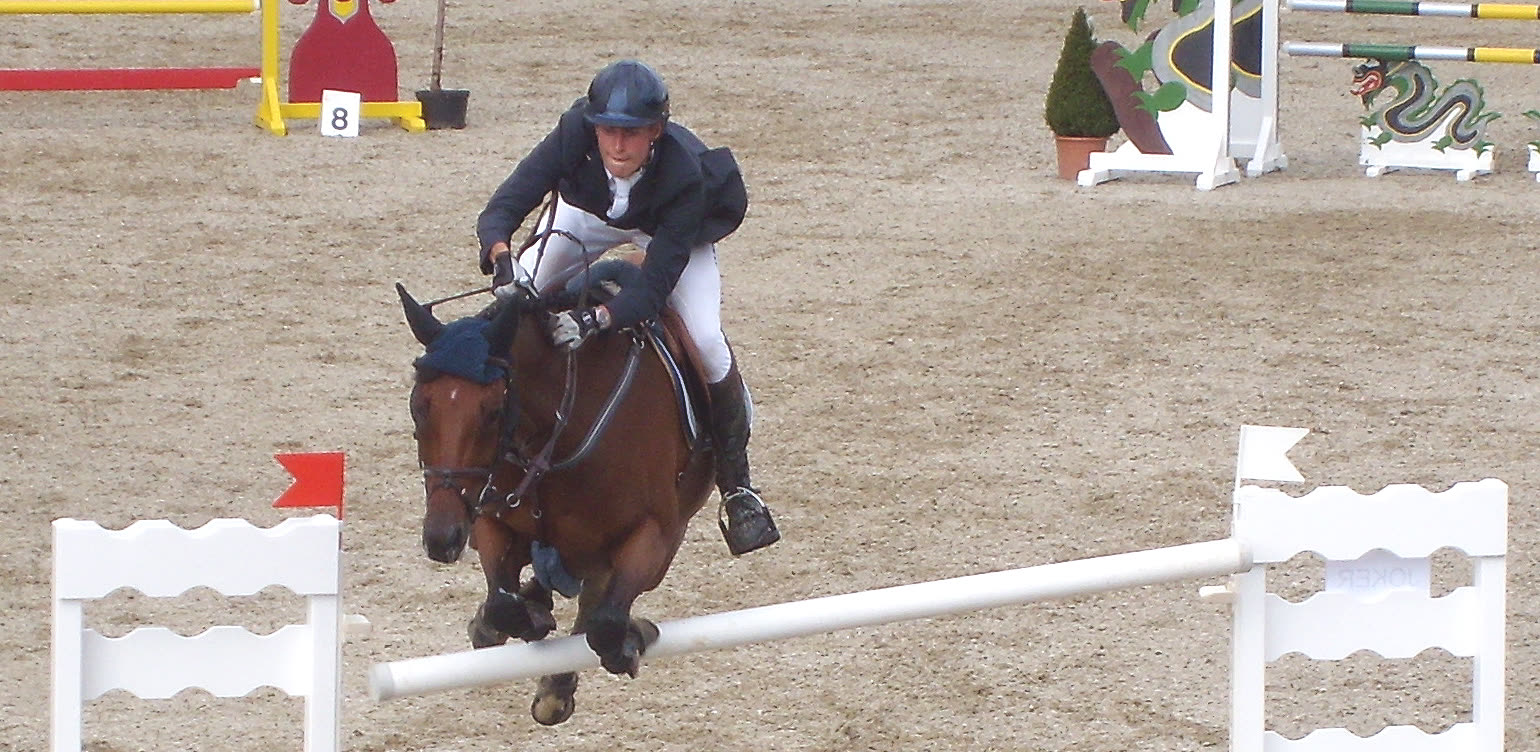
A show jumping result depends on how cleanly and how quickly the course was ridden. The FEI Jumping Rules require every competition to be scored under either Table A or Table C. Under Table A, the most common, a knock-down and a first refusal each cost 4 penalties, every second over the time allowed costs 1, and a second refusal or a fall means immediate elimination. A round with no penalties at all is called a clear round.
Table A: adding up penalties
Table A, set out in Article 217 of the FEI rules, fixes a penalty for each fault and adds up everything incurred in the round. The main items are:
- Obstacle knocked down: 4 penalties
- First disobedience (refusal, run-out and so on): 4 penalties
- Fault at the water jump: 4 penalties
- Exceeding the time allowed: 1 penalty for each second commenced
- Second disobedience, fall of horse or rider, exceeding the time limit, uncorrected deviation from the course, unauthorised assistance: elimination
"Each second commenced" means any fraction counts as a full second. In the example given by Wikipedia, a rider who finishes in 73.09 seconds against a time allowed of 72 seconds gets 2 time penalties. Official results must show the total penalties and list time penalties separately. When riders are level on penalties, the schedule decides whether time separates them or whether there is a jump-off over a shortened course.
What counts as a knock-down
Under Article 245, a knock-down occurs when the whole obstacle or any upper part in the same vertical plane falls, or when at least one end of a pole no longer rests on its support. It still counts if the falling pole is stopped by another part of the obstacle. When several poles sit one above the other in the same vertical plane, only the fall of the top one is penalised. On a spread fence jumped in one effort, several top poles falling still count as one fault.
Touching or rattling a pole that stays up is not penalised, and neither is knocking over the flags or the filling, such as trees or hedges. At the last fence, a pole that falls after the finish line still counts if it drops before the rider leaves the arena or the bell rings for the next starter.
At the water jump (Article 236), it is a fault if a hoof touches the water or leaves a mark on the lath (a wooden strip covered with plasticine) that marks the landing edge. Hitting the low brush or take-off element is not a fault.
Refusals, run-outs and resistance: two and you are out
Article 246 lists four kinds of disobedience: a refusal, when the horse stops in front of a fence; a run-out, when it avoids the fence; a resistance, when it will not go forward, steps back or rears; and circling off the course. If the horse stops without stepping back or knocking anything down and then jumps at once from a standstill, it is not a refusal. A resistance that lasts 45 seconds leads to elimination.
Disobedience penalties add up across the whole round, not just at one fence. One refusal at fence 1 and another at fence 8 make two, which means elimination. If the horse knocks down a fence while refusing, it is penalised only as a refusal, not a knock-down. The clock stops while the fence is rebuilt, and 6 seconds are then added to the rider's time (Article 256). According to Wikipedia, a refusal inside a combination (two or three fences one or two strides apart) means jumping the whole combination again from the first element, and each element knocked down costs 4 penalties.
Time penalties and Table C
The time allowed is calculated from the length of the course and the set speed (Article 252), and the time limit is twice the time allowed (Article 253). Exceeding the time limit means elimination.
Table C is used for speed classes. Faults are converted into seconds and added to the rider's time, and the fastest rider wins. As a rule, a knock-down adds 4 seconds outdoors and 3 seconds indoors. A first refusal adds no seconds, but the clock does not stop during a refusal, so the time spent is still recorded. A refusal that knocks down a fence adds 6 seconds. Table C has no time allowed, and the time limit is 3 minutes for a course of 600 m or more and 2 minutes for a shorter one. Under the full revision of the rules for 2026, the FEI moved the Children and Pony Championships from Table A to Table C.
The rules have not always looked like this. According to Wikipedia, the first British rules in 1925 gave 4 faults for each of the first two refusals and eliminated the horse at the third, and a quarter of a penalty for each second over the time used to be a common rule. Details can still differ by country and level, so riders should check the scoring table in the schedule and on the course plan before they compete.