
Riding
Canter leads and lead changes: simple and flying changes
· 4 min read
The lead is the left or right pair of legs that reaches further forward in the canter, and a lead change switches it to the other side. It can be done through the walk as a simple change, or in the air as a flying change, with the front and hind legs changing together.
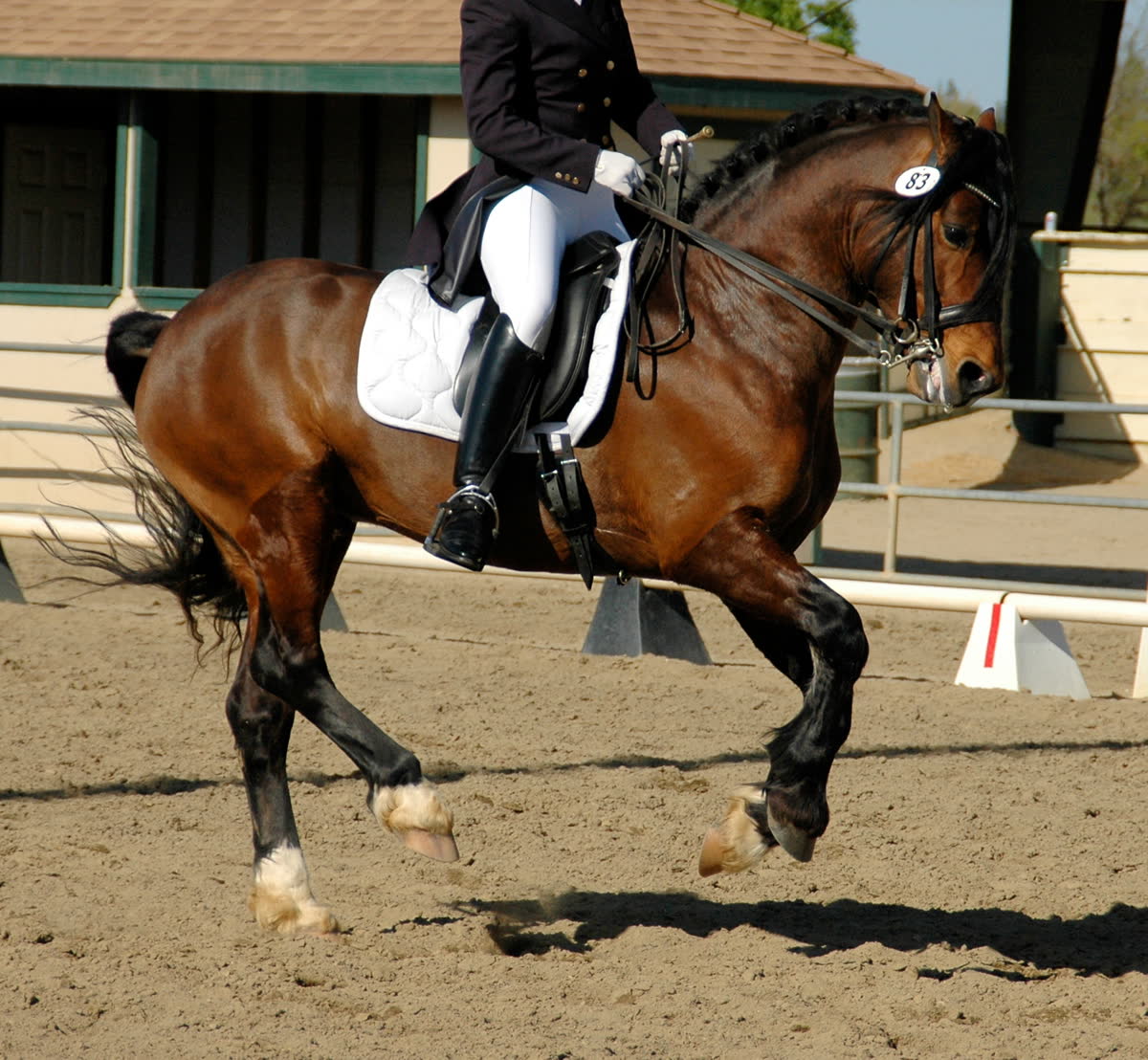
The lead is the side, left or right, whose legs reach further forward when a horse canters or gallops. If the left legs lead, the horse is on the left lead; if the right legs lead, it is on the right lead. A lead change is the switch from one lead to the other while the horse is moving, and Wikipedia divides it into three kinds: simple changes, flying changes and tempi changes, a series of flying changes.
The lead is set by the order of footfalls
The canter is a three-beat gait. On the right lead, the left hind is the first beat, the right hind and left fore land together as the second beat, and the right fore is the third beat. A moment of suspension follows, when all four feet are off the ground. On the left lead the sequence is mirrored. Both the front and hind legs on the leading side reach further than their partners, so someone watching from the ground can tell the lead by seeing which feet land further forward.
The normal canter for a horse is one in which the hind leg on the same side as the leading foreleg reaches further. There is also a canter in which the front legs are on one lead and the hind legs on the other, called a disunited canter or cross-canter. In the second beat, the horse is then supported by the front and hind legs on the same side rather than by a diagonal pair. This makes it hard to keep rhythm and impulsion, and the rider feels an awkward, twisting motion. In dogs and deer this form is the norm, but in most equestrian competitions where gaits are judged it is treated as a fault and penalised. In racing it is common at the start.
Why the correct lead matters
The lead that matches the direction of the turn is normally the correct one: the right lead when turning right, the left lead when turning left. Horses lean into a turn, and on the right lead in a right turn, the right hind steps further under the body and the right fore further in front, acting as stabilisers. On a straight line the lead matters little, but the tighter or faster the turn, the bigger the difference. On the wrong lead in a tight turn at speed, a horse can lose its footing and fall. Just as people favour one hand, most horses have a side on which they find it easier to canter.
The exception is the counter-canter, in which the horse deliberately takes the other lead, for example cantering on the right lead while circling left. The FEI Dressage Judging Manual defines it as a balancing and straightening movement that must be ridden in collected canter, a canter with shorter strides and more weight on the hind legs. The horse leads with the outside foreleg, is positioned slightly towards the leading leg, and the foreleg should stay on the same track as the hind leg. The counter-canter is also a stepping stone to the flying change. Riders usually start with a very shallow loop on the long side of the arena, make the loop deeper as the horse improves, and finally ride a 20-metre circle in counter-canter.
Simple, flying and tempi changes
- Simple change: the horse leaves the canter briefly and strikes off again on the other lead. In practice many riders change through a few trot steps, but the FEI manual defines it as a direct, smooth transition from canter to walk, three to five clearly defined walk steps, and then an immediate transition into canter on the other lead. At higher levels a simple change through the halt may be asked for instead.
- Flying change: the lead of the front and hind legs changes at the same moment, during the suspension phase of a single canter stride. The FEI manual says the rider's aids, the signals given to the horse, should be precise and unobtrusive, and that the aim is to show the horse's reaction, sensitivity and obedience to the aids.
- Tempi changes: flying changes ridden in series, every fourth, third, second or single stride. Tests start with changes every four strides, which gives time to prepare, and the interval shortens as the level rises. In one-tempi changes the horse often looks as if it is skipping.
What judges look for, and common faults
The first fault the FEI manual lists for the flying change is the front or hind legs changing late. According to the manual, if the canter stays disunited for one stride the mark is below 5, and if it stays disunited for several strides the mark is 1 to 3. If the horse changes before the aid, or late after it, 0.5 to 1 point is deducted and the mark cannot exceed 6. A flying change after an extended canter across the diagonal should come on the last stride of the diagonal; changing on the track or in the corner costs 0.5 to 1 point.
In show jumping, eventing and hunter classes, a flying change is essential when the course changes direction. On the wrong lead a horse can become unbalanced in the turn, take off unbalanced and hit a rail. Show jumping does not judge the change itself, but hunter classes penalise a poor or missed change. Horses also tend to switch leads as they jump, so a horse approaching on the right lead often lands on the left. Racehorses change leads too. A tired leading leg slows the horse down, so in North America, where races run counter-clockwise, horses are trained to use the left lead on the turns and the right lead on the straights.
The flying change is a relatively advanced movement. The usual order is to build the horse's self-carriage first through the counter-canter and simple changes through the walk, and then teach the flying change.