
Riding
The basics of riding circles and turns
· 4 min read
Riding a circle or turn correctly means the horse bends its body to match the curve of the line and its hind feet follow in the tracks of the forefeet. The 20-metre circle, the 8 or 10-metre volte and the corner are the basic figures, and the roles of the inside leg and outside rein need to be understood together.
Riding a circle or turn correctly means the horse bends from head to tail to match the curve of the line it is on, and its hind feet step exactly in the tracks of its forefeet. A United States Dressage Federation (USDF) document reproducing the German National Equestrian Federation's handbook says a rider can only ride turns and circles correctly once they can bend the horse laterally in this way. The FEI Dressage Judging Manual says that at changes of direction the horse should adjust the bend of its body to the curvature of the line, stay supple, follow the rider without resistance, and keep the same pace, rhythm and speed.
Circle sizes and names
The FEI manual lists the figures used in dressage tests as the volte, the half volte, the serpentine and the figure of eight. A volte is a small circle of 8 or 10 metres in diameter; anything larger than 10 metres is simply a circle. The basic large circle is 20 metres across. A half volte is half of a 10-metre circle, after which the horse returns to the track at a set marker and changes direction. A figure of eight joins two circles of the same size at the centre, and the horse should be straightened for a moment just before it changes direction there.
Corners are turns too. The FEI manual treats the right-angled turn through a corner as a quarter of a volte of about 6 metres. The 1985 German handbook defined the volte itself as 6 metres across and described it as the smallest circle, one that can only be ridden in collected paces. Any smaller, it explained, and the horse can no longer bend along the line, so the quarters swing out and the rhythm breaks. This differs from the volte sizes in today's FEI rules, so it is worth checking which standard a source is using.
How the legs and reins work
The German handbook in the USDF document says that in a correctly ridden turn or circle the horse's inside hind leg carries more weight than the outside one. Before the turn the rider prepares the horse with a half-halt and shifts their weight a little onto the inside seat bone. The aids, the signals given to the horse, are then shared out as follows.
- Inside rein: turns the horse's head slightly to the inside and shows the direction of the turn. Once the turn begins, its influence is reduced again.
- Inside leg: placed close to the girth, it asks the inside hind leg to reach further forward, keeps the bend and stops the horse falling in on the circle.
- Outside rein: gives just enough to allow the inside bend, while stopping the horse falling out through the outside shoulder and holding the line of the circle.
- Outside leg: placed a little behind the girth, it stops the quarters drifting out.
The same document warns that overusing the inside rein makes the quarters fall out or breaks the rhythm. It also lists a common corner mistake: moving both hands to the outside so the inside hand crosses over the mane in an attempt to ride deeper into the corner, which makes the horse fall out over its outside shoulder.
How much does the horse really bend?
Riding manuals teach that a horse bends through its back to follow a circle, but few studies had measured this. A 2021 study in Scientific Reports used motion capture to compare spinal movement in 12 unridden horses trotting on a lunge circle with a radius of about 5 metres and on a straight line. On the circle, the thoracolumbar back bent about 3.6 to 3.8 degrees further to the inside than on the straight, and the neck about 4.8 to 5.2 degrees. The researchers noted that the differences were small and may or may not be visible to the human eye, but that changes in muscle activity and limb movement may add to the impression of bend.
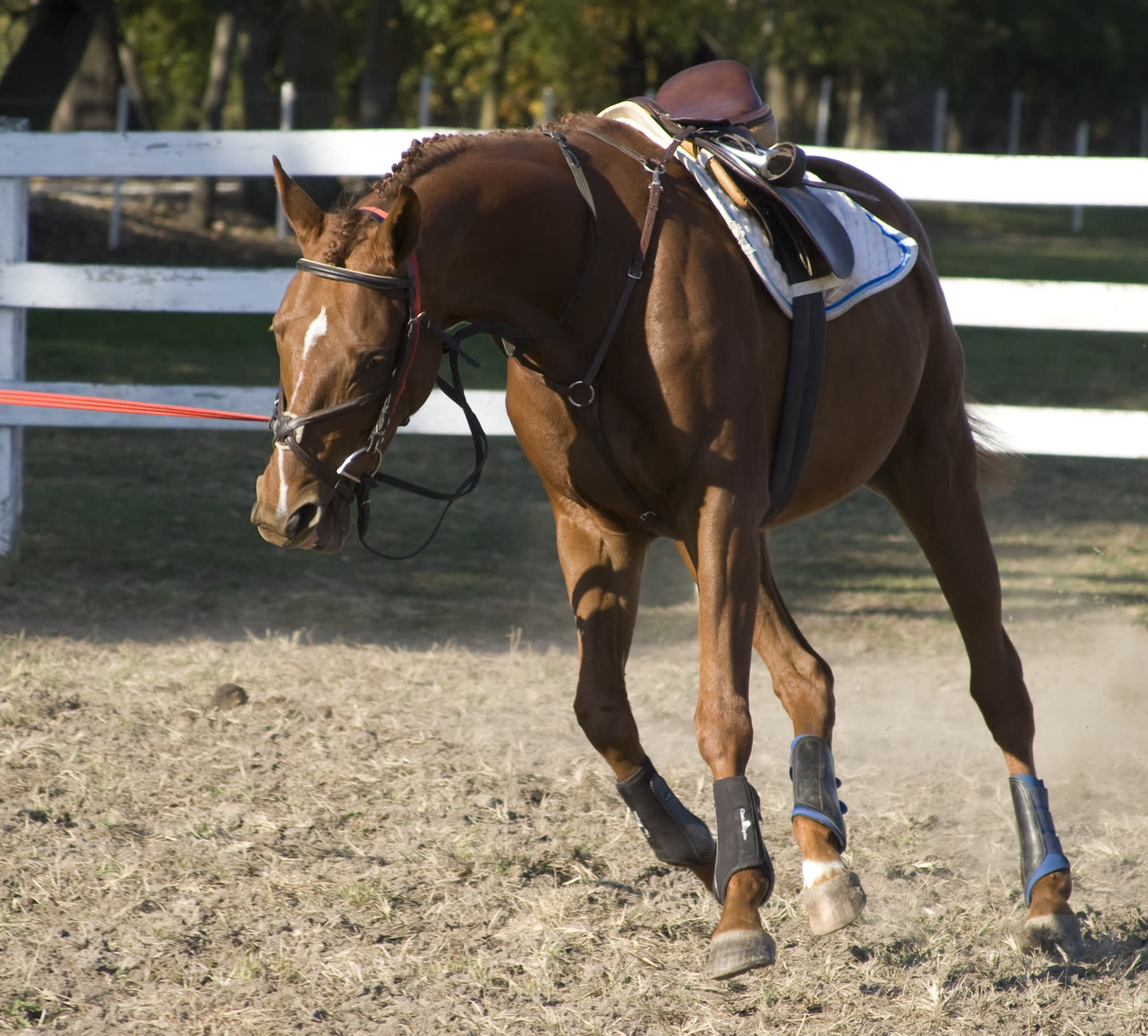
In the same study, horses on the circle leaned inward by roughly 12 to 13 degrees more than on the straight, a difference likely to be visible. On a circle, the inside front and hind legs take shorter strides than the outside legs, carry lower peak forces and stay on the ground longer. A horse leans in on a circle, as in the photo above, to produce the force towards the centre that it needs to stay balanced.
Common faults in competition
In an article for the USDF newsletter, judge Kathy Rowse writes that judges often see 18-metre circles at the ends of the arena, at A and C, and 24-metre circles in the middle, at B and E. Egg-shaped circles are another common fault. Thinking of four points on the circle as the corners of a diamond and riding from point to point makes it easier to hold the line. When a judge writes "too large" about a volte, she explains, it means the horse drifted out through the outside aids.
The FEI manual says that voltes and circles are judged on accuracy of place, size and shape, with 0.5 to 1 point deducted for imprecise riding. It notes that half circles on the 20-metre circle often come out too flat instead of keeping a 10-metre radius. Rowse adds, however, that judges see correct basics as more important than accurate geometry. A horse that responds well to the aids can be adjusted easily, and correctly sized, well-shaped circles follow from that.
Sources
- FEI, Dressage Judging Manual (effective 1 January 2024)
- USDF Teaching Manual appendix, Basic Exercises and Dressage Movements (excerpted from the German National Equestrian Federation's Principles of Riding, 1985 edition)
- USDF Connection, September 2016, Geometry Class (Kathy Rowse)
- Scientific Reports, Byström et al., Differences in equine spinal kinematics between straight line and circle in trot, 18 June 2021