
Riding
How to protect yourself when falling off a horse
· 4 min read
If a fall cannot be avoided, let go of the reins, kick free of the stirrups, tuck your chin, curl into a ball and roll away from the horse. This is not something you can work out in the moment, so it needs to be practised in advance.
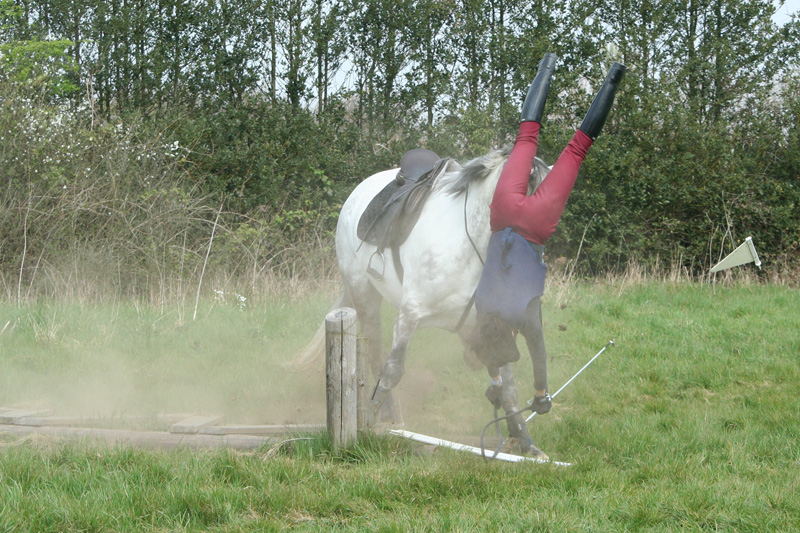
When a fall can no longer be avoided, the basic response is to stop clinging to the horse: let go of the reins, kick free of the stirrups, tuck your chin towards your chest, curl into a ball as you fall, and roll away from the horse. That is how fall safety trainers quoted by the American magazine Horse Journals in September 2025 describe it. None of this comes from thinking in the moment of a fall, so it has to be practised on soft ground beforehand until it becomes automatic.
Why prepare for falls
A study in BMJ Open Sport & Exercise Medicine (2018) analysed 7,815 horse-related injuries recorded by hospitals and health centres in the Skaraborg region of Sweden between 2001 and 2016. The most common type of incident was a fall from or with the horse, at 58.4%. Such falls also caused 63.9% of head injuries and 82% of concussions. The researchers also cite earlier work showing that head injuries are the leading cause of death in horse-related accidents. Kicks and being pushed by a horse do happen, but when riding, falling is the most common danger.
In the Horse Journals article, Danny Warrington, a former steeplechase jockey who runs the US fall training organisation Landsafe Equestrian, explains that a fall takes about 0.75 seconds on average to reach the ground, while human reaction time is about 0.25 seconds. The time is short, but there is enough of it to change the shape of your body. The article points out that riding lessons teach people how to stay on the horse but rarely how to fall.
What to do as you fall
Lindsay Nylund, who runs fall safety training in Australia, says that once there is no prospect of regaining balance, riders should follow this sequence.
- Let go of the reins. Holding on can leave you tangled and dragged, kicked or trampled, and it stops you using your arms to protect yourself. The horse can be caught later.
- Kick your feet out of the stirrups. Falling with a foot caught can mean being dragged by the horse.
- Tuck your chin towards your chest, wrap both arms, elbows slightly bent, around your head and neck, and draw your knees up so your body curls into a ball. Turn the hands inward to reduce the risk of wrist and elbow injuries.
- When you land, roll away from the horse and hold the tucked position until you have stopped completely.
Nylund teaches the same body shape whatever the direction of the fall, because there is no time to think about direction in mid-air. The University of Kentucky Equine Programs safety guide also says that when a horse is completely out of control it is better to bail out than to hang on too long, and that riders should roll as they fall so the whole body absorbs the impact.
Common mistakes and misconceptions
Warrington lists common mistakes as following the horse's ears with the eyes into the ground, holding the reins too long and so being unable to put the arms out, and failing to tuck the chin and round the back.
Nylund also corrects several misconceptions. The first is that relaxing your body means less injury. A good tuck-and-roll needs muscle tension; he says a rider should fall not like a raw egg but like a hard-boiled one. The second is the advice not to use your arms because they might break. In the worst falls, such as going head first, the arms need to reduce the force reaching the head and neck. The third is the belief that you can change direction in mid-air. Once airborne, the trajectory cannot be changed; only the body shape can. The fourth is that there is no time to react. If nobody could respond within 0.75 seconds, he argues, sports such as gymnastics and baseball could not exist.
How to practise
The Horse Journals article recommends practising on soft ground such as a sand arena, wearing normal riding clothes and a helmet, with someone present to watch and film. Kneeling on one knee, turn your head and shoulders away from the direction of the fall, drop onto the blade of the shoulder, then stay curled and roll across your back onto your knees and stand straight up. Repeat this many times in both directions, and once comfortable, start from a low mounting block and raise the height a little at a time. In vaulting, the gymnastic discipline performed on horseback, rolling is taught on mats from the very beginning, and vaulters must always finish the roll back on their feet so they can move away from danger.
The University of Missouri Extension guide also describes the emergency dismount, a way of jumping off a horse quickly. It should be practised at length on a quiet, well-trained horse in an arena, starting at walk, then trot and finally canter. Kick both feet out of the stirrups and place the hands, still holding the reins, on the withers, the high point where the neck meets the back. Using the horse's movement, push away with the hands, swing the right leg over the croup and land with both legs together. Practise on both sides, and, as the Kentucky guide stresses, learn it from a trained instructor.
After a fall
The University of Kentucky guide advises getting medical attention straight away after a fall or a kick, even if you seem fine, because damage to organs such as the liver or spleen may not show at first. The Missouri guide says a helmet that has hit the ground may have hidden damage and should be replaced with a new one.
Sources
- Horse Journals, How to Fall Off a Horse (Margaret Evans), 23 September 2025
- BMJ Open Sport & Exercise Medicine, Meredith et al., Horse-related incidents and factors for predicting injuries to the head, 13 August 2018
- University of Kentucky Equine Programs, Saddle Up Safely: Emergencies
- University of Missouri Extension, Safe Riding: Practical Guidelines for Horse and Rider (G2882)