
Riding
Riding helmet safety standards and when to replace a helmet
· 4 min read
Check the label inside a riding helmet for both a testing standard and a quality testing mark. Replace a helmet straight away after a fall in which your head hit the ground, even if it looks undamaged, and otherwise every three to five years, as the FEI recommends.
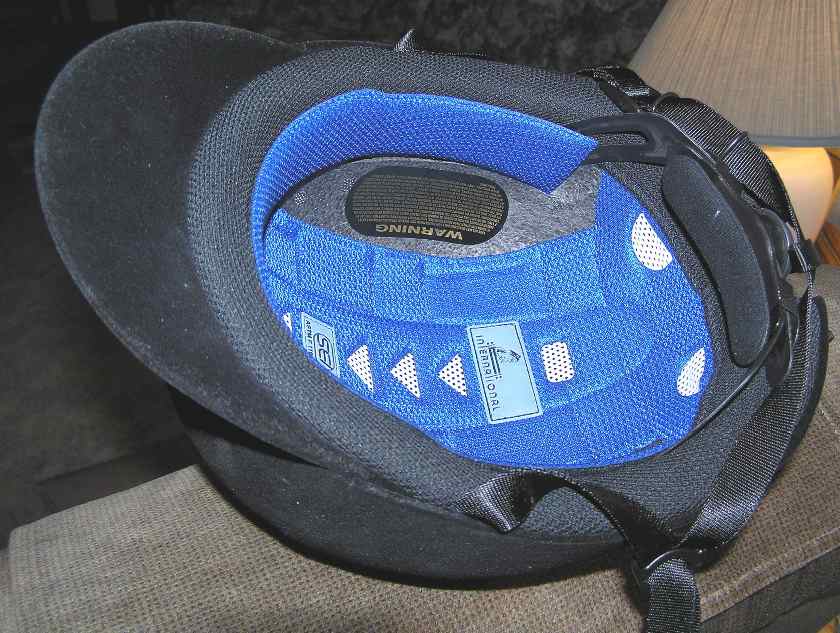
When choosing a riding helmet, look at the label inside for two things: the testing standard it has passed and a quality testing mark showing that it continues to meet that standard. The International Equestrian Federation (FEI) recommends replacing a helmet straight away after a fall in which your head hit the ground, even if it looks fine, and otherwise every three to five years depending on how often it is used. A helmet reduces head injury by absorbing and spreading the energy of an impact, and the FEI explains that a helmet that has taken one significant impact may not absorb a second one properly.
Two marks on the label
A label inside the helmet shows which testing standard it meets. The main standards are PAS 015 from the UK, the European EN 1384 and its earlier interim version VG1, ASTM F1163 and Snell E2016 and E2021 from the US, and AS/NZS 3838 from Australia and New Zealand. These standards test impact absorption, resistance to sharp objects passing through the shell (penetration resistance), the strength of the chin strap and other parts of the retention system, and how well the helmet stays in place on the head.
The testing standard alone is not enough; a quality testing mark should be there too. Quality testing is an ongoing check that production helmets keep to the level of the original test. British Eventing accepts PAS 015 and EN 1384 or VG1 with a BSI Kitemark or Inspec IC mark, ASTM F1163 with an SEI mark, and AS/NZS 3838 with a SAI Global mark. Snell includes quality testing within the standard, so no separate mark is needed. The British Horse Society (BHS) also regards a helmet with a quality mark as safer than one tested to the same standard without it. The University of Missouri guide notes that the label also shows the date of manufacture.
How the FEI standards change step by step
At FEI events, riders must wear properly fastened headgear while mounted, and the headgear must meet the FEI list of accepted testing standards. The list that took effect on 1 January 2026 changes in stages up to 2028.
- 2026: any one of PAS 015:2011, Snell E2016 or E2021, EN 1384:2023, ASTM F1163-23, ASTM F1163-15, VG1 or EN 1384:2017, and AS/NZS 3838 (2006). The older ASTM F1163:2004a and F1163-13 and Snell E2001 are not accepted.
- 2027: AS/NZS 3838 (2006) is dropped, and VG1 or EN 1384:2017 and ASTM F1163-15 are accepted only together with one of the other four standards.
- From 2028: a helmet must meet at least two of four standards: PAS 015, Snell, EN 1384:2023 and ASTM F1163-23.
The FEI says it is phasing some standards out gradually because of manufacturing constraints and product availability. It also states that meeting a standard does not mean the FEI certifies or recommends a helmet, and it does not allow products to be described as "FEI certified".
Passing a standard does not mean equal performance
According to a 2025 paper by researchers at Virginia Tech in the US, most current equestrian helmet standards are pass or fail tests: a head form wearing the helmet is dropped from about 1.8 m onto a flat steel anvil, and the test checks that head acceleration stays under a limit. There is no limit on rotational acceleration of the head. The researchers ran 720 impact tests on 45 helmet models, including angled impacts, and found that the worst-performing helmet carried nearly four times the concussion risk of the best. The same paper cites earlier research showing that wearing a helmet reduces head injuries by 30 percent and severe head injuries by 50 percent. The FEI Helmet Working Group, set up in 2023, has also proposed ways to strengthen helmet testing standards.
When to replace a helmet
- After a fall in which your head hit the ground: both British Eventing and the University of Missouri advise replacing it at once. Damage inside may not be visible.
- With age: the FEI and British Eventing recommend three to five years, because sweat, UV light and everyday use weaken the protective materials. The University of Missouri guide says every six years, so the advice varies between organisations.
- After dropping it: the BHS explains that every drop or knock can reduce a helmet's protection.
Because damage to a second-hand helmet cannot be seen, both the BHS and the University of Missouri advise buying a new one.
Fit and care
A helmet should sit level on the head, feel snug without pressure points, and stay in place when gently rocked. A poorly fitting helmet can move during a fall and protect less well. Check that the chin strap stitching is not coming loose or fraying and that the buckle fastens firmly every time. The FEI recommends trying a helmet on before use even if it was bought online, and ideally having it fitted by a qualified professional. Helmets for children can be a different shape from adult helmets, even within the same brand.
The BHS advises against leaving a helmet in direct sunlight for long periods, and says a wet helmet should dry naturally rather than on a radiator. Heat and sunlight can also weaken the protective structure inside the helmet.
Sources
- FEI, Accepted Testing Standards for Protective Headgear, published 1 July 2025, effective 1 January 2026
- FEI, Protective Headgear
- British Eventing BE Prepared (Charles Owen), Understanding Helmet and Body Protector Standards
- The British Horse Society, Hats & helmets, reviewed 2 January 2026
- University of Missouri Extension, Safe Riding: Practical Guidelines for Horse and Rider (G2882)
- Annals of Biomedical Engineering, Duma et al., Equestrian STAR, 28 April 2025