
Horse science
Naming White Face Markings: Yuseong and Biryangbaek
· 4 min read
Korean registration names face markings by position (seong on the forehead, yuseong running down, biryangbaek on the bridge, bibaek on the nose) and sizes them against a thumb joint, a fist and the nasal bone. Present from birth and unchanging, they help identify horses.
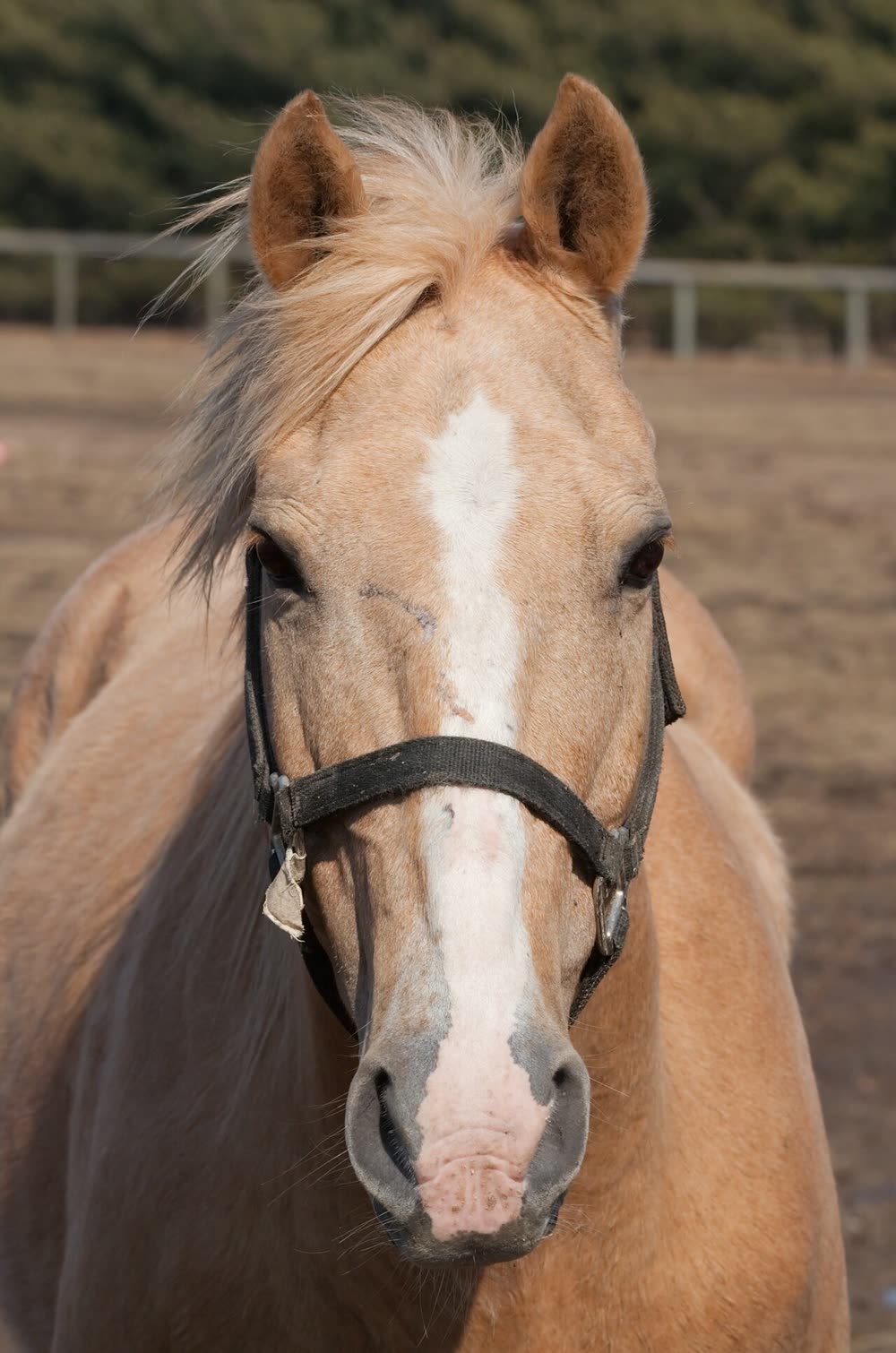
After coat colour, the white markings on a horse's face are the next clue to who it is. The individual identification guide used for horse registration by the Korea Racing Authority (한국마사회) names face markings by position: seong (star) on the forehead, yuseong (flowing star) when the white runs down from the forehead towards the nose, biryangbaek on the bridge of the nose, and bibaek on the nose. Size is judged against the first joint of the thumb, a fist and the width of the nasal bone. Markings are present from birth and do not change, so even when many horses share a coat colour, the face can single out one horse.
White marks and scattered white hairs
The guide first sorts white hair on the face into two kinds. A white mark (heenjeom) is an area of clear, dense white hair. Scattered white hairs (saechi) are a looser group of white hairs, less dense than a white mark. On the horse diagram in the registration papers, a white mark is outlined in red pen, while scattered white hairs are drawn as a broken line (///). Names such as seong, yuseong and biryangbaek all apply to white marks.
Identification follows a set order: coat colour, sex, and any brand or tattoo, then the head, neck and chest, the left side of the mane and legs, the body, the tail and the right side, before a final look at the whole horse. Face markings come straight after coat colour in this sequence.
Seong on the forehead and yuseong running down
A white mark on the forehead is a seong. If it is wider than the first joint of the thumb but smaller than a fist, it is a seong. If it is smaller than the thumb joint, it is a soseong (small star), and if it is larger than a fist, it is a daeseong (large star). By shape, a mark curved like a crescent is a gokseong, a ring-shaped mark is a hwanseong, and a mark with an irregular, misshapen outline is a nanseong.
When the white mark runs down from the forehead towards the bridge of the nose, it is a yuseong. The width thresholds are the same as for seong, giving soyuseong, yuseong and daeyuseong. Marks that combine this shape with the curved, ring or irregular forms are called gokyuseong, hwanyuseong and nanyuseong.
Biryangbaek on the bridge and bibaek on the nose
Biryang is the Sino-Korean word for the bridge of the nose. White marks there are divided into three by size.
- Biryangsebaek: a white mark narrower than the first joint of the thumb
- Biryangbaek: a white mark at least as wide as the thumb joint but no wider than the nasal bone
- Biryangdaebaek: a white mark wider than the nasal bone
The nose itself is divided by the same measures into bisobaek, bibaek and bidaebaek. A ring-shaped mark of any size is a hwanbiryangbaek on the bridge and a hwanbibaek on the nose. When white covers more than half of the face from the forehead to the lips and is wide enough to reach both eyes, it is a baekmyeon (white face).
When several marks appear together, they are written in order from the forehead down to the nose. For example, "yuseong-biryangbaek" means a yuseong and a biryangbaek joined without a break. A marking with a gap is given the prefix "dan" (broken): "yuseong-danbiryangbaek-bibaek" means there is a gap between the yuseong and the biryangbaek, while the biryangbaek and the bibaek are joined.
English names and points to keep in mind
In English, a forehead marking is a star, a narrow line down the middle of the face is a stripe or strip, a wide one is a blaze, a very wide marking that reaches the eyes is a bald face, and a marking between the nostrils is a snip. English names mostly describe markings by shape and position, whereas the Korean system also divides them by size using the thumb joint, the fist and the nasal bone. As a result, the two sets of names do not always match one to one.
Pink spots on the lips are treated separately from white markings. A horse's skin is naturally mouse-grey, but pink spots sometimes appear on the almost hairless skin around the lips and nostrils. These are called lip spots (ipsuljeom), and white hairs on the lips are recorded as scattered white hairs.
A common misconception: not all white hair is a marking
According to the Wikipedia article on horse markings, the skin under most white markings is pink, and the shape of a marking is set at birth and does not change. A marking may look slightly different as the winter coat grows in or sheds, but that is only a matter of hair length. White hair can also grow over an injury or where a poorly fitting saddle has pressed for a long time, but that is a scar, not a natural marking. The Korean guide also records scars separately from white marks, using an arrow (→).
Grey horses turn white with age, so face markings visible in youth gradually disappear. In that case, the hair can be clipped short and wetted to see whether the skin underneath is pink or black. Chestnut horses are also known to tend to have more extensive white markings than bay or black horses.