
Horse science
The Three Foundation Sires of the Thoroughbred
· 4 min read
Every modern Thoroughbred traces back to three stallions brought to England in the 17th and 18th centuries: the Byerley Turk, the Darley Arabian and the Godolphin Arabian. Their male lines survived through Herod, Eclipse and Matchem, and 95% of male Thoroughbreds carry a Y chromosome from the Darley Arabian.
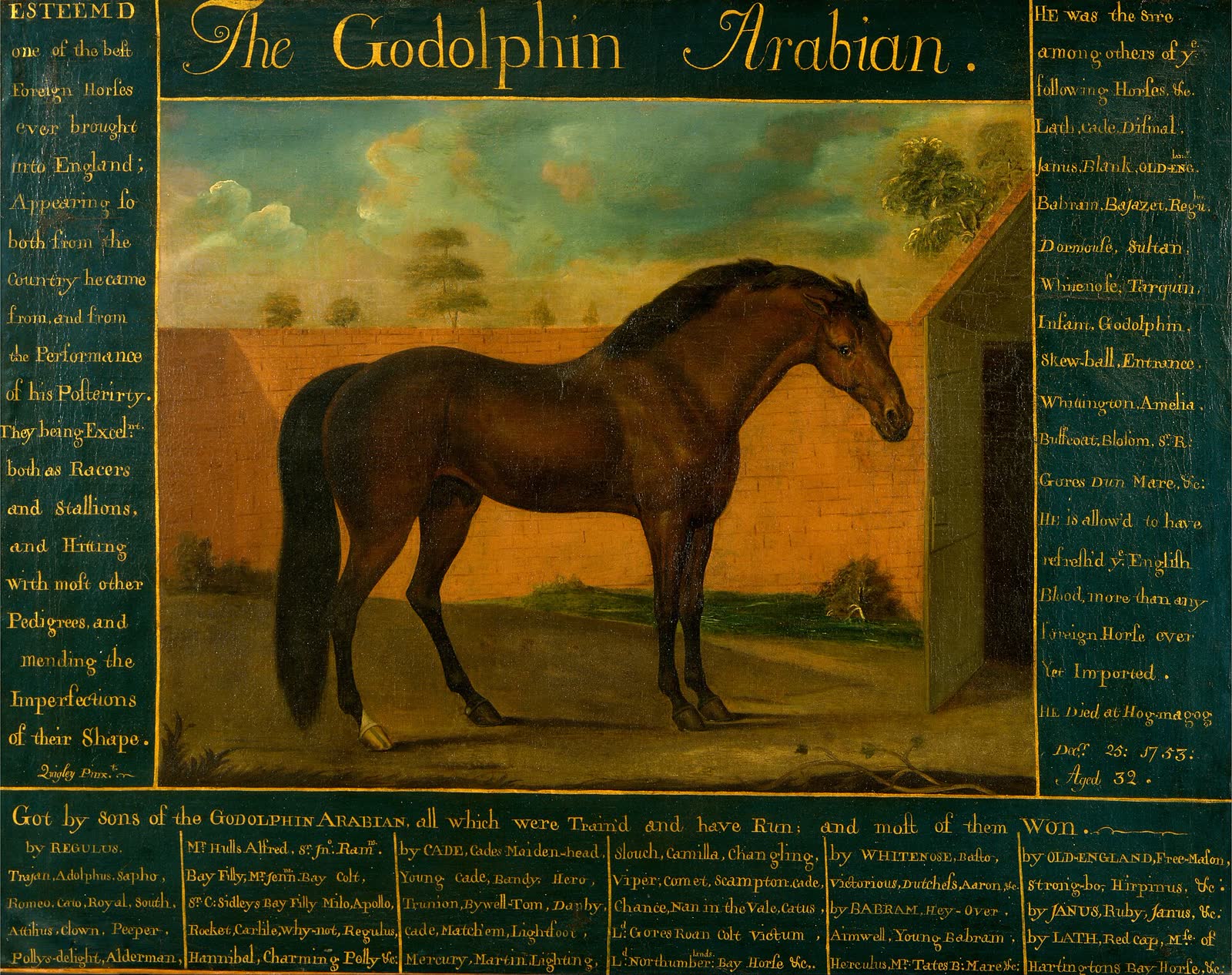
Every Thoroughbred in the world today traces its pedigree back to three stallions that arrived in England between the late 17th and early 18th centuries: the Byerley Turk (1680s), the Darley Arabian (1704) and the Godolphin Arabian (1729). They are known as the foundation sires, the stallions at the root of the breed. The Thoroughbred was developed in England for racing. It took shape in the 17th and 18th centuries, when native English mares were bred to imported stallions of Arabian, Barb and Turkoman breeding. Barbs come from North Africa and Turkoman horses from Central Asia.
Who the three stallions were
The Byerley Turk was the earliest of the three to enter English bloodlines. He was born around 1680 and died around 1703. He was the war horse of Captain Robert Byerley, who was sent to Ireland in 1689 during King William's War and also served at the Battle of the Boyne. The most popular theory is that the horse was captured at the Battle of Buda in 1686, but his origins are uncertain. He is recorded as dark brown or black. After the captain retired, the horse went to stud and from 1697 stood at Goldsborough Hall in England, though he did not cover many well-bred mares.
The Darley Arabian was a bay Arabian born around 1700. In 1704 Thomas Darley bought him in Aleppo, Syria, and shipped him to Aldby Park in England as a present for his brother. He stood about 15 hands (about 152 cm) and was the leading sire in Great Britain and Ireland in 1722. Among his offspring was Flying Childers, a racehorse that was never beaten.
The Godolphin Arabian was a bay stallion born around 1724, possibly in Yemen. He passed through the stud of the Bey of Tunis and was given to King Louis XV of France in 1730, but he was not valued there. He later went to England and, after several owners, settled at the stud of the Earl of Godolphin. At 15 hands (152 cm) he was small, and he had an unusually high crest along the top of the neck. At first he was not used as a breeding stallion but as a teaser, a stallion used to check whether a mare is ready to breed. Then another stallion refused to cover the mare Roxana, and the Godolphin Arabian covered her instead. Their colt Lath won the Queen's Plate at Newmarket nine times out of nine starts. The Godolphin Arabian went on to be leading sire in 1738, 1745 and 1747.
The three descendants who carried the male lines
The male line of each foundation sire, passed only from father to son, has by coincidence survived to the present through a single descendant.
- Herod (foaled 1758): a great-great-grandson of the Byerley Turk. The line ran Byerley Turk, Jigg, Partner, Tartar, Herod. Herod was leading sire in Great Britain and Ireland from 1777 to 1784.
- Eclipse: a great-great-grandson of the Darley Arabian, the dominant racehorse of his day and never defeated.
- Matchem: a grandson of the Godolphin Arabian.
Most Thoroughbred sire lines today run through Eclipse back to the Darley Arabian. According to one genetic study, 95% of male Thoroughbreds trace to the Darley Arabian through the Y chromosome, the chromosome passed only from father to son. The Godolphin Arabian's male line is now rare, but famous American horses of the past such as Seabiscuit, Man o' War and War Admiral belonged to it.
What genetics says about the foundation sires
The Darley Arabian dominates the male lines, but the picture changes when all lines, including the dam's side, are counted. In modern Thoroughbred pedigrees, the Godolphin Arabian accounts for 13.8% of crosses, more than the Darley Arabian at 6.5%. Curwen's Bay Barb, which is not one of the three foundation sires, appears more often (4.2%) than the Byerley Turk (3.3%).
A 2017 study in the journal Current Biology analysed a 1.46 Mb section of the Y chromosome in 52 horses from 21 breeds. Apart from a few northern European lineages, most modern horse breeds fell into a single Y chromosome group about 700 years old, which reached Europe through imported Oriental stallions. The Oriental group splits into an original Arabian lineage and a Turkoman horse lineage, and the Y chromosome of the English Thoroughbred came from the Turkoman lineage. The researchers concluded that Thoroughbred sires were largely responsible for how widespread this Y chromosome is in modern breeds.
A common misconception: the breed did not come from three horses alone
The saying that every Thoroughbred descends from three horses refers to the male lines. The historical record traces about 160 imported stallions that contributed to the Thoroughbred, roughly half of them of Arabian breeding and the rest Turkoman or Barb. Horses other than the foundation sires also left their mark, such as the Brownlow Turk, who is thought to be largely responsible for the grey coat in Thoroughbreds. The breed also has many roots on the dam's side. The 19th-century researcher Bruce Lowe identified 50 mare families, later expanded to 74. However, mitochondrial DNA studies found that 19 lines thought to be separate actually traced to only 15 mares.
Names do not prove breeding either. The Godolphin Arabian was also called the Godolphin Barb, and historical accounts describe the Byerley Turk as an Arabian. Names at the time usually reflected where a horse came from or how it was brought in, so judging ancestry means looking at records and genetic studies together rather than at names. The Thoroughbred that resulted is used today not only for racing but also for show jumping, eventing and dressage, and it has influenced the development of several Warmblood breeds.