
Horse science
How horses live in herds, and how rank works
· 4 min read
Wild horses live in small groups built around mares and their young. Rank is kept mostly by lower-ranking horses giving way rather than by fighting, and it shows most clearly around food and water. A new horse is safest introduced to a herd in stages.
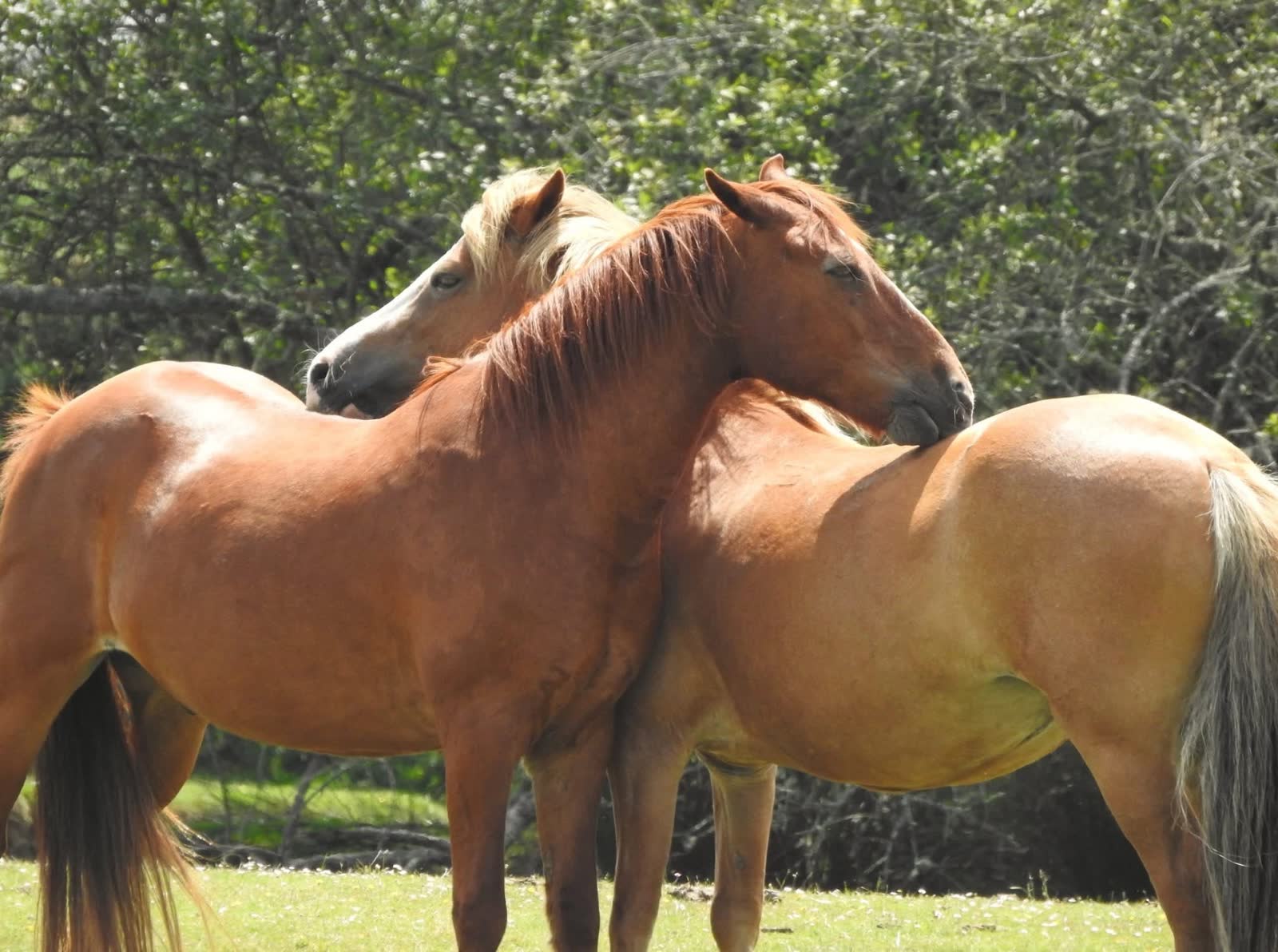
Horses are social animals that live in groups and prefer company to being alone. They survived as prey animals by running from predators, and being in a group helps them notice danger early and escape together. A herd does have a ranking, but it is far from a strict order settled by fighting. Rank is kept mostly by the lower-ranking horse giving way, and it shows most clearly around limited resources such as food and water.
How a wild herd is organised
A large herd of wild or feral horses (domestic horses that went free and now breed in the wild) is usually made up of several small "bands" that share the same area. According to Wikipedia, a band has between 2 and 25 animals, mostly mares and their young, with one to five stallions. The Merck Veterinary Manual says a band often consists of six to eight mares, their offspring aged three or younger, and one to six adult males.
Mares are the core of the group. They stay together even if the stallions leave or die. Bands do not hold territory; they move around in search of food and water.
Young horses leave the band they were born into at around sexual maturity. Fillies soon join another band. Colts usually leave before the age of two and join a "bachelor band" of young males. One interpretation is that this movement is an instinct that prevents inbreeding. The dominant stallion in a bachelor band is the most likely to take mares from another band and form his own. The Merck manual notes that a stallion usually acquires his mares by about five years old and loses them by about ten.
Who leads the herd
The idea that a stallion rules a group of mares is a common misconception. Stallions mostly stay on the edge of the band, driving off predators and other males. When the band travels, the stallion is usually at the rear, pushing stragglers forward to keep the group together. Most of the time he marks manure piles and urination spots with his scent to show that he is the band's stallion.
Where the band goes is usually decided by a mare. A dominant mare, often called the "lead mare", guides the group to food and water. According to the Merck manual, she starts a move not by herding the others but by grazing in the direction she wants to go, and the leader is usually the mare with the greatest need, the hungriest or thirstiest. Other observations suggest no single horse always leads. A 2014 study of feral horses in Italy found that any individual could start a move, although higher-ranked horses were followed more often.
How rank is settled
The Merck manual says rank among horses appears to be linear (the first outranks the second, the second outranks the third), and is not necessarily linked to age, weight, height, sex or time in the group. Wikipedia notes that non-linear rankings also occur, where A outranks B and B outranks C, yet C outranks A, and that dominance can shift with how much a horse needs a particular resource at the time. It also cites newer research finding no fixed "pecking order". The emphasis differs, but both agree that rank is kept by the lower horse giving way rather than by fighting.
Horses first signal with body language. If a signal such as pinned-back ears does not work, they bite, kick or push to make the other horse move. Usually the horse that makes the other step aside is the dominant one. Foals extend their necks and clack their teeth to calm an aggressive adult. Rank can be read by watching who gets scarce water or good grass first, and who threatens whom. Foals of high-ranking mares tend to reach high rank themselves later in life.
In domestic herds, stallions are often kept apart, so a mare or a gelding becomes dominant. Older horses usually rank higher, but they can lose their place when they become old and weak.
What to know when keeping and handling horses
Herd instinct shows when people handle horses, too. Some horses become anxious when separated from others, and a horse shut away alone where it cannot see other animals may become nervous and hard to manage. A horse kept alone also sleeps poorly because it cannot stop watching for danger. At feeding time, higher-ranking horses eat first, and when food is short the lower-ranking ones may get very little.
When adding a new horse to a herd, it is safer not to rush. The FEI describes these steps.
- Stable the horses side by side, or turn the newcomer out next to the herd with an alley between the fences, so they can see and smell each other.
- Let them smell each other's droppings as a first introduction.
- Pair the newcomer with one easy-going member of the herd first, add horses one at a time, then join the whole group.
- After the horses are together, keep watching from a safe distance for a few weeks.
The same article recommends clearing sharp objects from the paddock, removing hind shoes if kicking is a problem, spreading about twice as many hay piles as there are horses, and providing several water troughs. Before the new horse arrives, check vaccination records, and keep brushes and tack separate for a few weeks. If you see an injury after the horses have clashed, consult a vet.