
Horse science
How much horses sleep
· 4 min read
Adult horses sleep about 2.5 to 5 hours a day, mostly standing up. REM sleep only happens lying down, so a horse needs to be able to lie down for at least 30 minutes a day. When it cannot for several days, it may doze off standing and buckle.
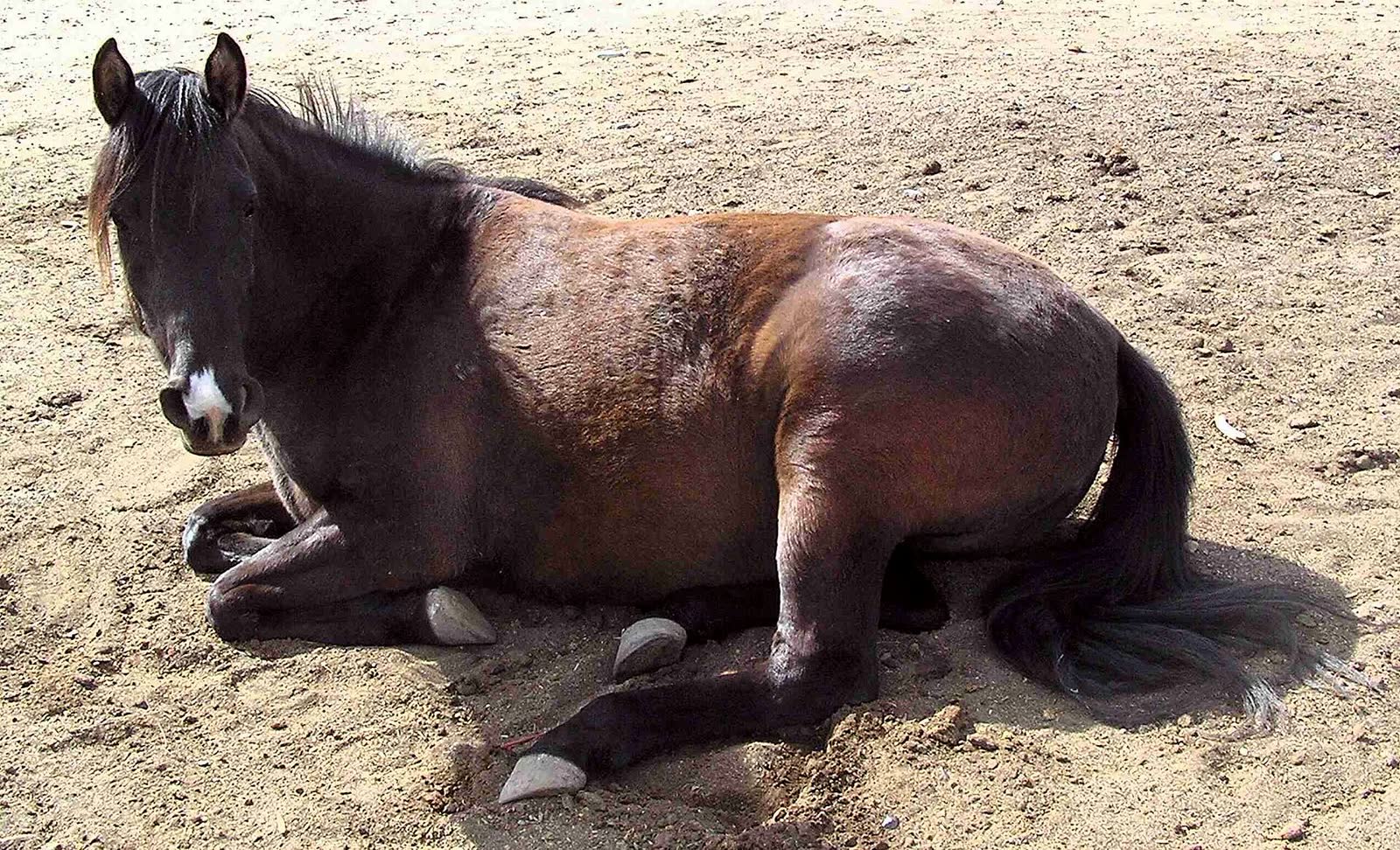
An adult horse actually sleeps only about 2.5 to 5 hours a day, and most of that standing up. But REM sleep, when muscle tone is fully released, only happens lying down, so a horse needs to be able to lie down for at least about 30 minutes a day. A horse that has nowhere suitable to lie, or does not feel safe, will not lie down. If that goes on, it may doze off on its feet and buckle.
Resting is not the same as sleeping
Horses spend most of the day eating, resting or sleeping. Kentucky Equine Research puts resting behaviour at about 5 to 7 hours a day. Wikipedia gives 4 to 15 hours a day of standing rest, and anything from a few minutes to several hours lying down. Not all of that rest is sleep.
A 2021 study in the journal Animals, drawing on earlier research, describes adult horses as sleeping 2.5 to 5 hours a day, 80% of it standing. Figures cited in the same paper divide a horse's day into about 18 hours awake, about 2 hours drowsy, about 3 hours of slow-wave sleep (non-REM sleep in which brain waves become slow and large) and less than an hour of REM sleep. Wikipedia says horses need about 2.5 hours of sleep a day on average, so the numbers vary between sources.
Many short sleeps
Horses do not sleep in one long stretch. They sleep in several short bouts, a habit that suits a prey animal that must be ready to run from a predator at any moment. The Animals paper says horses sleep in 5 to 7 episodes a day, mostly between midnight and 4 a.m. Kentucky Equine Research also notes that real sleep usually comes after midnight, in the dark hours. According to Wikipedia, one short sleep lasts about 15 minutes: five minutes of slow-wave sleep, five minutes of REM sleep, then another five minutes of slow-wave sleep.
A horse can doze or enter slow-wave sleep standing because of the stay apparatus in its legs, a structure that keeps the legs from folding with very little muscle effort. In REM sleep, however, muscle tone is lost, so a horse cannot reach REM sleep while standing.
Time lying down: on the chest and flat out
Earlier studies summarised in the Animals paper show that horses over four years old, whether domestic or living in near-wild conditions, spend 3 to 15% of the day (43 to 216 minutes) lying down. About 20 minutes of that (about 15%) is spent lying flat on the side. The rest is spent lying on the chest with the legs folded underneath. A horse is thought to need at least 30 minutes lying down a day to get 3.5 to 4.5 minutes of REM sleep. Wikipedia says lying down for an hour or two every few days is enough to meet the minimum REM requirement.
Age also matters. Foals lie down for much longer than adults, and domestic foals have been reported lying down for up to 53.1% of the day.
The same study fitted wearable sensors to 83 horses at an animal sanctuary to measure lying time. It varied widely, from 0 to 319 minutes a day, with an average of 67.4 minutes. Neither age nor chronic lameness made a clear difference to lying time.
Why some horses do not lie down
Horses lie down only when they feel safe, because lying down leaves them more exposed to predators. Kentucky Equine Research lists the main reasons a horse may not lie down: surroundings such as lack of space or bad weather, insecurity from low rank in the herd, and pain in the muscles, bones or joints. Overweight horses may also find it hard to lie down and get up again.
The ground matters too. Horses prefer dry, clean, soft surfaces. In a 2017 study described by Kentucky Equine Research, horses with only hard rubber mats rarely lay down, and lying time rose as the bedded area grew larger. With a large bedded area, low-ranking horses lay down as much as high-ranking ones. With a small one, competition was fiercer, and low-ranking horses were sometimes forced to get up while lying down.
Horses in a group sleep better, because some can sleep while others keep watch. A horse kept entirely alone may sleep poorly, because its instinct is to keep watching for danger.
Signs of too little sleep
When a horse cannot lie down to sleep for days, it becomes short of REM sleep. Such a horse is very drowsy and may fall asleep standing, then buckle at the legs and wake suddenly. A typical sign is scraped skin on the front of the knees (carpi) and the front fetlocks. In the Animals study, the eight horses with these signs lay down for only about 8 minutes a day on average, far less than the other horses (about 74 minutes).
These collapses are often mistaken for narcolepsy, but narcolepsy is a rare neurological disorder with a different cause. Researchers have also looked at the effects of lost sleep. In a 2024 experiment, ten Lusitano horses were kept from lying down for 72 hours. They showed a tendency to take longer on a spatial memory task, but the difference did not reach statistical significance.
If a horse often sways while standing or has unexplained scrapes on the front of its knees, check its bedding and herd setup and talk to a veterinarian.
Sources
- Wikipedia, Horse behavior
- Animals (2021), Recumbency as an Equine Welfare Indicator in Geriatric Horses and Horses with Chronic Orthopaedic Disease
- Kentucky Equine Research, Sleep Requirements of Horses, 19 April 2017
- Animals (2024), Sleep Pattern Interference in the Cognitive Performance of Lusitano Horses