
Horse science
How horses smell, and what the flehmen response is
· 4 min read
Horses have a far keener sense of smell than humans, with a main olfactory system for general odours and a vomeronasal organ for pheromones. The flehmen response, head raised and upper lip curled, is not a smile but a way of moving scent to the vomeronasal organ.
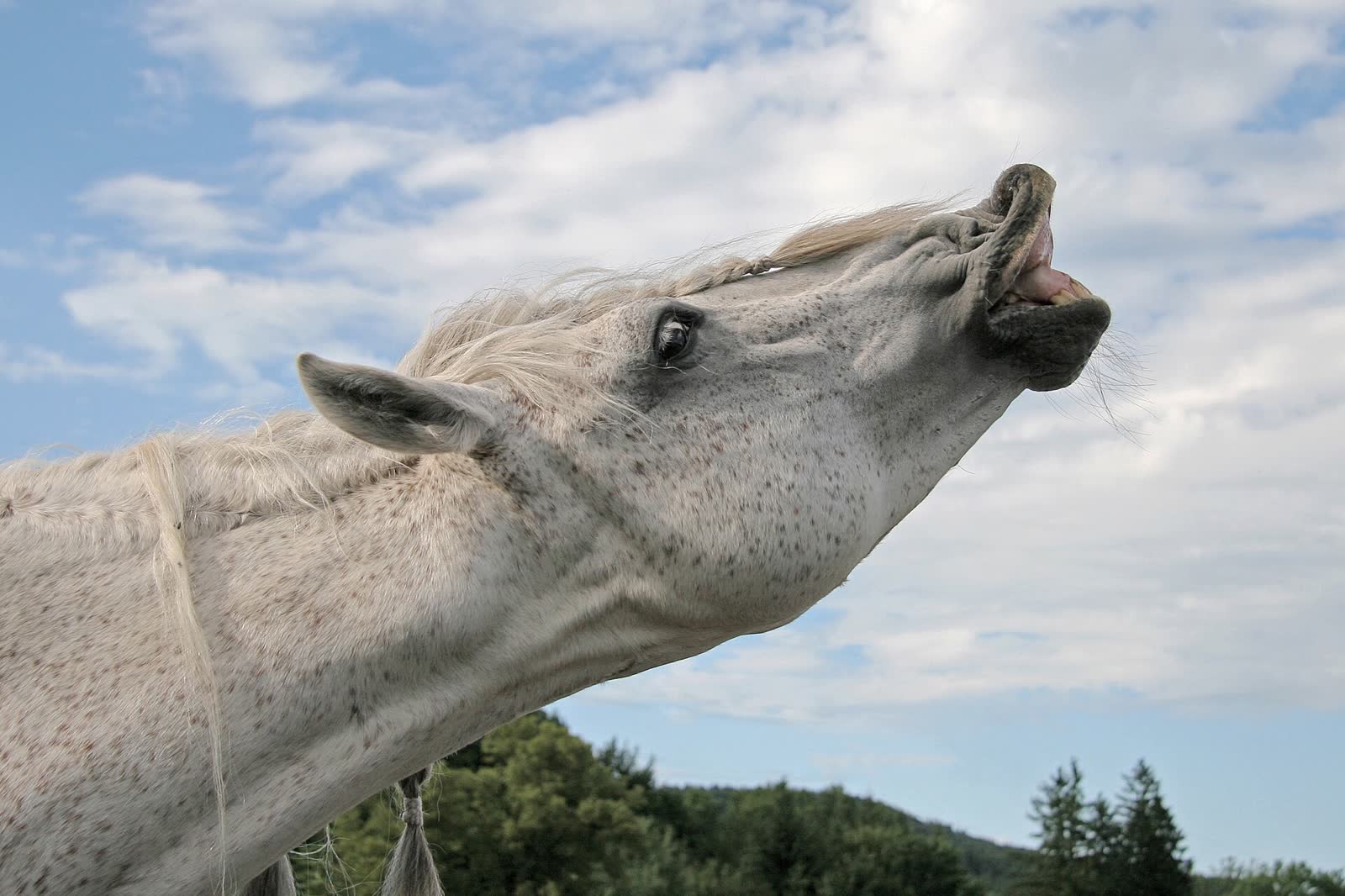
A horse's sense of smell is much better than a human's, though not quite as good as a dog's. Horses have two systems for detecting odours in the nose. One is the main olfactory system in the nostrils and nasal cavity, which picks up a wide range of smells. The other is the vomeronasal organ (Jacobson's organ), which detects chemical signals that do not evaporate easily, such as pheromones. When a horse lifts its head and curls its upper lip back to show its teeth, it is not laughing. This flehmen response moves scent towards the vomeronasal organ.
Two smell systems inside the nose
Horses do not breathe through the mouth; they breathe only through the nose. They can draw in large volumes of air, and they are among the land vertebrates with the highest number of olfactory receptors. Sniffing strengthens the airflow inside the nasal passages, so odour molecules make better contact with the receptors. A 2023 review in the journal Animals notes that a horse's two nostrils are set apart and point in different directions, and that the nasal septum, the wall dividing the two nasal cavities, is 20 to 30 cm long.
The olfactory epithelium, the layer of cells that detects odours in the main system, is concentrated in the upper, rear part of the nasal cavity. The vomeronasal organ is a pair of tubes wrapped in cartilage at the base of the nasal septum. It detects substances of low or no volatility, the kind found in urine and body secretions. Its signals travel to the brain along a separate nerve pathway.
The two systems were once thought to handle entirely separate sets of odours. More recent research suggests they work together, and that some substances are detected by both. One example is a study showing that Thoroughbreds detect androstenone, a steroid pheromone, through the same receptor found in both the vomeronasal organ and the olfactory epithelium.
How the flehmen response works
Flehmen comes from a German word meaning "to bare the upper teeth". The horse stretches its neck, raises its nose, opens its mouth slightly and curls its upper lip. It often inhales and then holds the position for several seconds. This reduces air leaking out through the nostrils and raises the pressure inside the nasal cavity, which is thought to let the vomeronasal organ analyse low-volatility compounds more accurately.
In many mammals, such as dogs, cattle and pigs, ducts behind the front teeth connect the mouth to the vomeronasal organ. Horses do not breathe through the mouth and lack this connection; their vomeronasal organ opens only into the nasal cavity. That is why a horse's flehmen depends on air drawn in through the nose.
When horses show flehmen
- It is most common in stallions after smelling another horse's urine or droppings, especially a mare's. Even so, horses of any sex can show it.
- Mares often show flehmen in the first few hours after giving birth, while smelling the foal and the amniotic fluid.
- Young horses of both sexes show it, and one report found that young colts do so up to five times more often than fillies.
- It can also follow a strange, strong smell such as peppermint essential oil.
In one study, stallions showed frequent flehmen to the urine of mares in oestrus, mares out of oestrus and geldings, and responded more to another stallion's urine than to a gelding's. In the same experiment, flehmen in geldings was very rare.
A world read through scent
When horses meet, sniffing nose to nose and nose to body is a common greeting. Horses are also very interested in the smell of other horses' droppings. In one study, mares and geldings sniffed other horses' droppings longer than their own, and paid particular attention to droppings from the horses that had been most aggressive towards them. Herd stallions mark dung piles and urination spots to signal their presence.
Human scent carries information for horses too. In a 2023 study in Scientific Reports, horses told apart the sweat of the same person collected while watching a horror film and while watching a comedy, and they sniffed the newly presented odour mainly with the right nostril. A follow-up study of 43 horses found that horses smelling sweat from a fear context startled more at a sudden event, reached a higher maximum heart rate and touched the person less. The researchers noted that a handler's emotional state may reach the horse through scent.
Common misconceptions and cautions
The flehmen response is not a horse laughing or mocking anyone. It is a way of examining a smell closely, so there is no reason to pull the horse's head down when it does this. Wikipedia does note, however, that flehmen outside its normal context, without an obvious smell, can be a sign of discomfort. If you see this repeatedly, look at it alongside any other changes in behaviour and consult a veterinarian.
Some studies report that the scent of essential oils such as lavender reduced stress responses in horses. The review above, however, also records a report that lavender's effect did not last once the scent was removed, and notes that results for a synthetic calming pheromone have been inconsistent across studies. Before bringing scents into a stable, it is safer to talk to a veterinarian or other specialist first.
Sources
- Wikipedia, Flehmen response
- Wikipedia, Horse
- Animals (2023), Olfactory Stimulation as Environmental Enrichment for Domestic Horses—A Review
- Scientific Reports (2023), Horses discriminate human body odors between fear and joy contexts in a habituation-discrimination protocol
- PLOS ONE, Human emotional odours influence horses' behaviour and physiology